10 Tools Every Cyber Security Expert Should Master in 2025
- 1 min read
Discover the 10 essential cyber security tools experts must master in 2025 to strengthen enterprise resilience and reduce digital risk.
Cyber Security in 2025 Is a Strategic Battlefield
Cyber threats are no longer isolated incidents. They are systemic business risks.
European enterprises face stricter regulations, including the NIS2 Directive, increased ransomware sophistication, and expanding cloud environments. Security leaders must combine regulatory alignment with technical precision.
Tool mastery now defines operational maturity. Not tool awareness. Not surface familiarity. Real operational command.
For CIOs and CISO-level decision-makers, understanding which tools matter most enables stronger procurement strategy and better vendor selection across the European IT ecosystem.
1. SIEM Platforms - The Core of Modern SOC Operations
Security Information and Event Management platforms centralize logs, correlate events, and enable real-time response.
Leading platforms include:
- Microsoft Sentinel
- Splunk Enterprise Security
- IBM QRadar
According to Gartner, SIEM modernization is a top investment priority for enterprise security teams.
Why it matters:
- Centralized visibility
- Automated alerting
- Regulatory reporting alignment
2. EDR and XDR Solutions - Endpoint Is the New Perimeter
With remote work and hybrid infrastructure, endpoints are primary attack vectors.
Enterprise-grade tools:
- CrowdStrike Falcon
- Microsoft Defender for Endpoint
- Palo Alto Cortex XDR
Benefits:
- Behavioral detection
- Ransomware containment
- Lateral movement prevention
3. Vulnerability Management Platforms
Continuous vulnerability scanning is critical for compliance and resilience.
Key tools:
- Tenable
- Qualys
- Rapid7 InsightVM
These platforms align well with frameworks from NIST and ISO 27001.
Capabilities:
- CVE prioritization
- Risk scoring
- Patch validation tracking
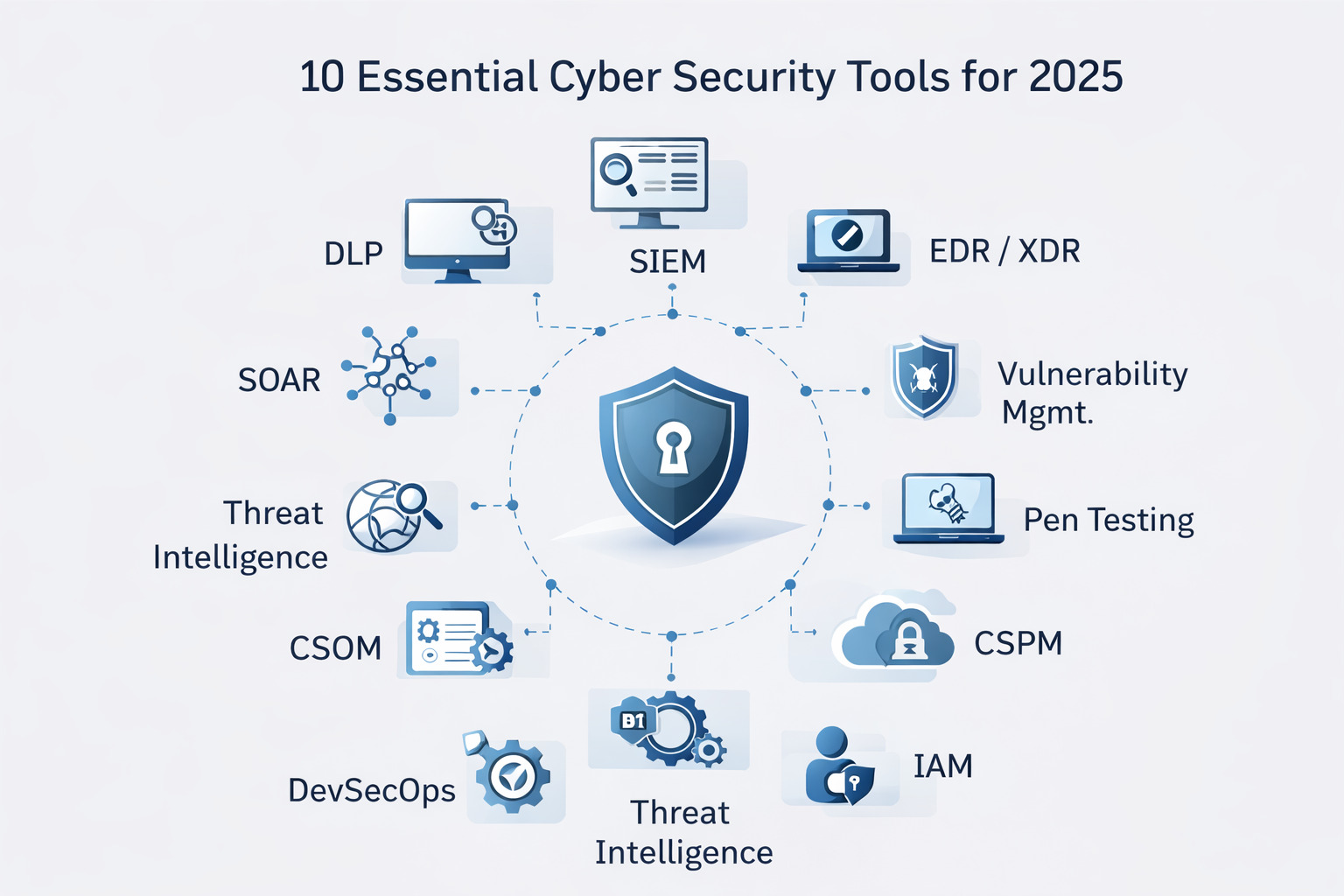
4. Penetration Testing Frameworks
Offensive security testing improves defensive posture.
Must-know tools:
- Metasploit
- Burp Suite
- Nmap
Pen testing validates real-world exposure and supports compliance audits.
5. Cloud Security Posture Management - CSPM
Cloud misconfigurations remain a leading breach cause.
CSPM platforms such as:
- Prisma Cloud
- Wiz
- Check Point CloudGuard
Provide:
- Misconfiguration detection
- Multi-cloud visibility
- Compliance monitoring
6. Identity and Access Management - IAM
Zero Trust architectures depend on identity control.
Core technologies:
- Okta
- Azure Active Directory
- Ping Identity
Identity-first security reduces credential-based attacks significantly.
7. DevSecOps Security Scanning Tools
Security must integrate into CI/CD pipelines.
Critical tools:
- Snyk
- Checkmarx
- SonarQube
Embedding security early reduces remediation costs dramatically.
8. Threat Intelligence Platforms
Proactive intelligence reduces response time.
Enterprise solutions:
- Recorded Future
- Mandiant Threat Intelligence
- Anomali
These tools enable:
- IOC enrichment
- Risk forecasting
- Adversary profiling
9. SOAR Platforms - Security Automation
Security Orchestration, Automation, and Response platforms reduce analyst workload.
Key players:
- Palo Alto Cortex XSOAR
- Splunk SOAR
- IBM Resilient
Automation improves response speed and reduces SOC fatigue.
10. Data Loss Prevention - DLP
Data sovereignty and GDPR compliance demand visibility over data movement.
Enterprise DLP tools:
- Symantec DLP
- Microsoft Purview
- Forcepoint DLP
They protect intellectual property and sensitive customer data.
Industry Insight
According to the European Union Agency for Cybersecurity, ransomware attacks across EU member states increased significantly over recent years, with cloud misconfiguration and identity compromise leading root causes.
Gartner projects that by 2026, organizations prioritizing cyber resilience over pure prevention will reduce financial impact of incidents by nearly 40 percent.
Tool integration, not tool accumulation, differentiates mature security programs.
Euro IT Sourcing Perspective
From our experience working with European enterprises, security success rarely depends on isolated tooling decisions.
We observe that high-performing organizations:
- Align tools with governance frameworks
- Integrate security into development lifecycles
- Automate repetitive SOC processes
- Maintain strong identity governance
The most common failure pattern is fragmented tooling without architectural cohesion.
Security architecture must scale with cloud, AI, and distributed workforce models.
Business Impact of Tool Mastery
Organizations that strategically deploy and integrate advanced security tools achieve:
- Faster threat detection
- Reduced incident response time
- Improved audit readiness
- Lower long-term remediation costs
Well-integrated SOC environments can reduce mean time to detect and respond by over 50 percent.
In 2025, resilience is a measurable competitive advantage.
Key Takeaways
- SIEM and XDR platforms form the operational backbone of enterprise security.
- Identity and cloud security are non-negotiable in hybrid environments.
- DevSecOps integration reduces long-term risk exposure.
- Automation improves efficiency and analyst capacity.
- Tool strategy must align with regulatory and business objectives.
Author & Contact
Author: Matt Borekci https://www.linkedin.com/in/matt-borekci
Contact Us: https://www.euroitsourcing.com/en/contact
What Does a Cyber Security Expert Do? A Complete Guide
Discover what a cyber security expert does, their roles, skills, and how they protect businesses from digital threats.

How Much Does a Cyber Security Expert Earn? Salary Insights for 2025
Explore 2025 cybersecurity salary trends, including global averages, roles in demand, and how outsourcing impacts IT security hiring.