Avoiding Vendor Lock-In with Flexible Outsourcing Contracts
- 1 min read
Learn how flexible outsourcing contracts help enterprises avoid vendor lock-in, reduce risk, and maintain long-term IT agility.

Introduction
In today’s fast-moving digital economy, IT outsourcing is no longer a long-term fixed bet. Enterprises must adapt quickly to changing technologies, market conditions, and internal priorities.
Yet many organizations find themselves constrained by vendor lock-in, where rigid contracts limit flexibility, innovation, and negotiating power. This risk has become more visible as cloud platforms, managed services, and outsourced development grow more complex.
Understanding how to structure flexible outsourcing contracts is now a critical capability for CTOs, CIOs, and procurement leaders seeking long-term resilience and control.
The Challenge: Hidden Risks of Vendor Lock-In
Vendor lock-in often emerges gradually, not by design.
Common risk factors include:
- Long-term exclusive contracts with limited exit options
- Proprietary tools or undocumented custom frameworks
- Lack of knowledge transfer or internal capability building
- Dependencies on a single vendor for critical systems
Over time, these constraints can lead to:
- Reduced bargaining power
- Higher switching costs
- Slower innovation cycles
- Increased operational and security risks
According to the European Commission, vendor lock-in is a key barrier to fair competition and digital sovereignty in IT services. https://digital-strategy.ec.europa.eu
The Approach: Designing Flexible Outsourcing Contracts
Avoiding vendor lock-in starts at the contract level.
Effective outsourcing agreements emphasize modularity, transparency, and optionality rather than rigid long-term commitments.
Key principles include:
- Clearly defined scopes with independent service modules
- Shorter contract terms with renewal-based extensions
- Explicit exit and transition clauses
- Ownership clarity for code, data, and documentation
This approach ensures that outsourcing remains a strategic enabler, not a structural dependency.
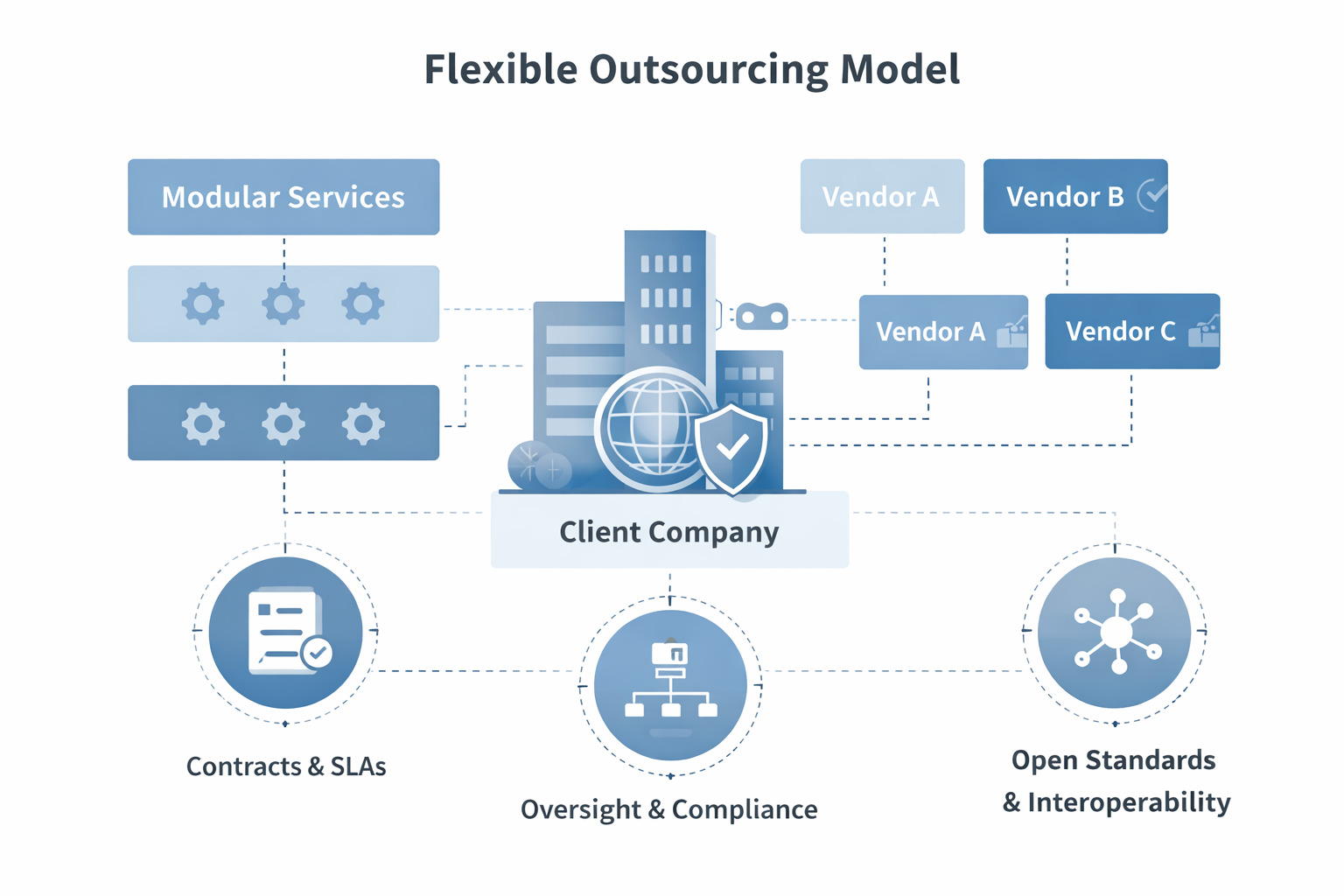
Contract Structures That Reduce Dependency
Modular Service Design
Breaking services into independent components allows organizations to:
- Replace or rebalance vendors incrementally
- Scale specific capabilities without full contract renegotiation
- Maintain architectural and operational control
Knowledge Transfer Requirements
Contracts should mandate:
- Continuous documentation updates
- Code repositories owned by the client
- Regular handover sessions
- Onboarding playbooks for new teams
ISO/IEC 12207 highlights lifecycle transparency and knowledge continuity as core software governance principles. https://www.iso.org
The Technology Factor: Open Standards and Interoperability
Technology choices directly influence contractual freedom.
Best practices include:
- Favoring open-source or widely adopted frameworks
- Avoiding proprietary deployment pipelines without alternatives
- Ensuring API-based integrations and standard data formats
NIST emphasizes interoperability and portability as foundational principles for reducing vendor dependency in outsourced systems. https://www.nist.gov
Industry Insight
Gartner reports that organizations using multi-vendor or modular outsourcing models reduce switching costs by up to 30 percent compared to single-vendor arrangements.
Additionally, McKinsey highlights that companies with flexible sourcing strategies achieve faster time-to-market during periods of rapid digital change. https://www.mckinsey.com
These findings reinforce the shift from monolithic outsourcing contracts toward adaptive, governance-driven models.
Euro IT Sourcing Perspective
From our experience working with European technology-driven companies, vendor lock-in is rarely caused by poor intent. It is usually the result of over-simplified contracts in complex environments.
We consistently see stronger outcomes when clients:
- Separate commercial terms from technical architecture decisions
- Maintain internal technical ownership, even when delivery is external
- Treat outsourcing partners as interchangeable contributors, not system owners
This mindset aligns well with Europe’s growing focus on digital sovereignty, resilience, and compliance.
Results and Business Impact
Organizations adopting flexible outsourcing contracts typically experience:
- Faster vendor transitions with minimal service disruption
- Improved cost transparency and negotiation leverage
- Better compliance with internal governance and EU regulations
- Higher innovation velocity through competitive sourcing
Industry benchmarks indicate that flexible sourcing models can reduce total outsourcing risk exposure by 20 to 35 percent over a three-year period.
Key Takeaways
- Vendor lock-in is primarily a contractual and governance issue, not just a technical one
- Modular, transparent contracts provide long-term strategic flexibility
- Open standards and documentation ownership are critical safeguards
- Multi-vendor readiness strengthens negotiating power and resilience
- Flexible outsourcing supports innovation without sacrificing control
Author and Contact
Author: Matt Borekci
Contact Us: Euro IT Sourcing
--

How to Build Resilient IT Teams with Hybrid Onshore-Offshore Outsourcing Models
Discover how hybrid onshore-offshore outsourcing builds resilient IT teams. Balance cost, quality, and scalability while ensuring 24/7 business continuity.

Cross-Border Compliance in Outsourcing: Navigating Global Regulations
Ensure your outsourcing strategy meets global standards—learn how cross-border compliance protects your business and fuels growth with Euro IT Sourcing.