Cloud Migration Projects: Why Outsource the Heavy Lifting?
- 1 min read
Discover why outsourcing cloud migration projects reduces risk, accelerates delivery, and improves cost control for modern enterprises.

Introduction
Cloud migration has become a strategic priority for enterprises aiming to improve scalability, resilience, and cost efficiency. Yet, many organizations underestimate the complexity behind moving critical systems, data, and workloads to the cloud.
From legacy dependencies to security and compliance concerns, cloud migration projects often strain internal IT teams beyond their core capacity. Delays, budget overruns, and operational disruptions are common when migration is treated as a purely technical exercise.
This is where outsourcing the heavy lifting becomes a pragmatic choice. When executed correctly, external cloud expertise enables organizations to migrate faster, safer, and with greater predictability.
The Challenge of Cloud Migration
Legacy Complexity and Technical Debt
Most enterprises operate hybrid environments built over years of incremental decisions. These environments often include:
- Monolithic applications with tight dependencies
- Outdated infrastructure and undocumented systems
- Custom integrations that resist standard migration paths
Untangling this complexity requires specialized skills that many internal teams do not maintain on a daily basis.
Security, Compliance, and Downtime Risks
Cloud migration is not just about infrastructure. It directly impacts:
- Data protection and regulatory compliance
- Business continuity and service availability
- Identity, access management, and monitoring
A single misconfiguration can introduce security gaps or cause costly downtime.
The Modern Approach to Cloud Migration
Structured Migration Frameworks
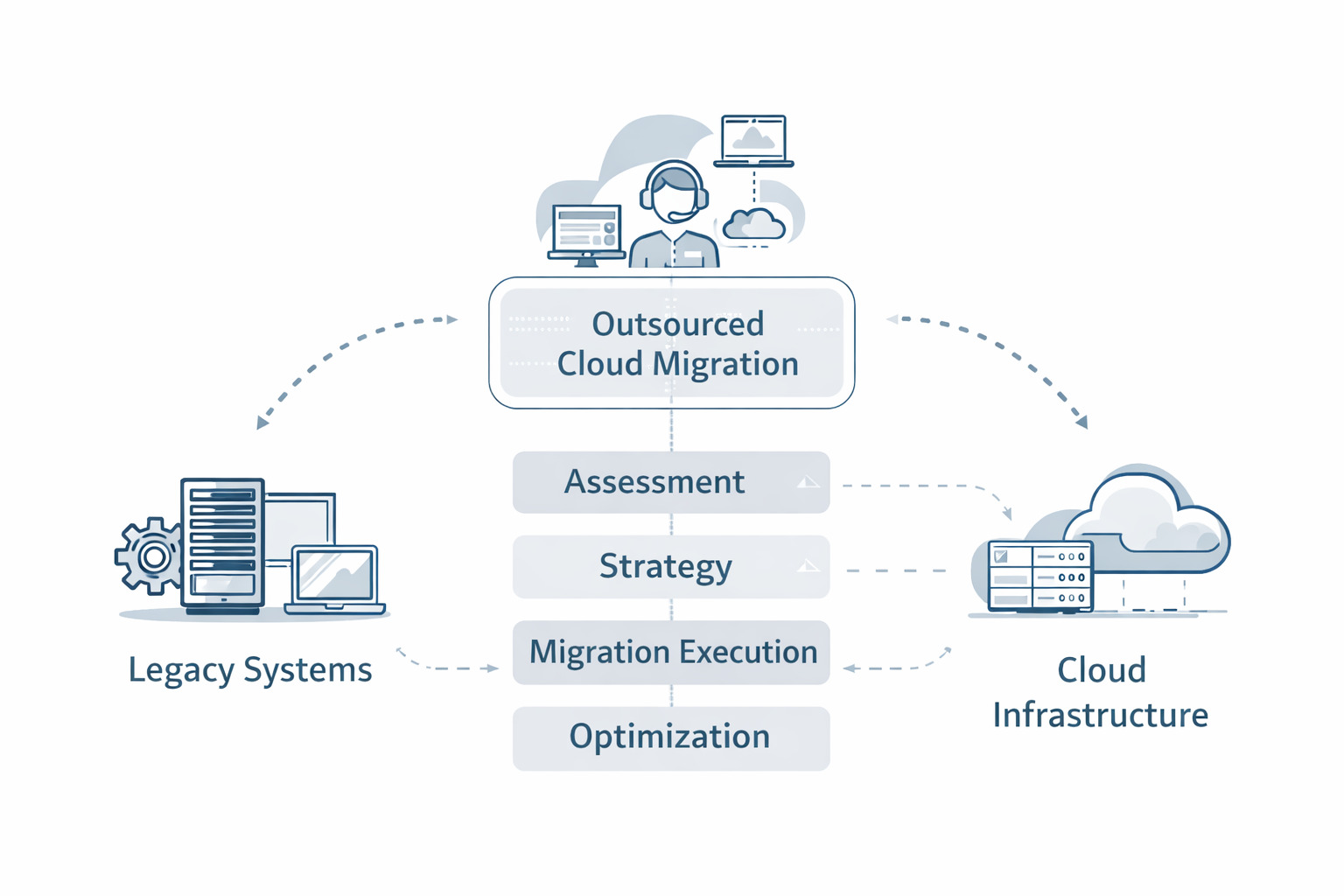
Successful migrations follow a clear, phased approach, typically including:
- Application and infrastructure assessment
- Migration strategy definition (rehost, refactor, replatform, retire)
- Pilot migrations and validation
- Full-scale execution and optimization
This structure reduces uncertainty and aligns technical decisions with business goals.
Focus on Business Outcomes
Rather than moving everything at once, leading organizations prioritize:
- High-impact workloads
- Systems with scalability or performance constraints
- Applications nearing end-of-life on legacy infrastructure
This ensures early value realization and internal stakeholder buy-in.
The Technology Factor
Modern cloud migrations rely on mature platforms and frameworks such as:
- Hyperscalers like AWS, Microsoft Azure, and Google Cloud
- Infrastructure-as-Code tools for repeatability and governance
- Cloud-native security and monitoring solutions
However, tools alone do not guarantee success. Expertise in designing, executing, and governing these tools is what separates smooth migrations from failed ones.
For reference, industry standards and guidance can be found from:
- NIST Cloud Computing Program https://www.nist.gov/programs-projects/nist-cloud-computing-program
- ISO/IEC 27001 information security framework https://www.iso.org/isoiec-27001-information-security.html
Industry Insight
According to Gartner, over 50 percent of enterprise cloud migrations exceed initial timelines due to underestimated complexity and skills gaps. At the same time, organizations that leverage external cloud specialists report faster time-to-value and improved cost governance.
McKinsey research further indicates that companies capturing full cloud value focus less on infrastructure ownership and more on execution excellence and operational maturity. https://www.mckinsey.com/capabilities/mckinsey-digital/our-insights
These insights reinforce a key trend: cloud migration success is increasingly tied to accessing the right expertise, not expanding internal headcount.
Euro IT Sourcing Perspective
From our experience working with European tech firms and enterprise clients, cloud migration projects succeed when internal teams remain focused on business-critical decisions while external partners handle execution complexity.
Common patterns we observe include:
- Internal IT teams overloaded with day-to-day operations
- Limited in-house exposure to large-scale cloud transformations
- The need for flexible, scalable delivery models
By integrating experienced cloud engineers into client projects, organizations gain execution capacity without long-term overhead, while maintaining architectural control and transparency.
Results and Business Impact
Organizations that outsource cloud migration execution typically achieve:
- Faster migration timelines by 30 to 40 percent
- Reduced operational risk through proven delivery frameworks
- Improved cost visibility and cloud spend optimization
- Higher system availability during and after migration
Beyond technical success, this approach allows leadership teams to focus on innovation and growth, rather than firefighting migration challenges.
Key Takeaways
- Cloud migration is a business transformation, not just an IT task
- Internal teams often lack the capacity and specialization required
- Outsourcing reduces risk, accelerates delivery, and improves predictability
- Structured frameworks and experienced execution are critical
- The right partner enables focus on outcomes, not infrastructure
Author & Contact
Author: Matt Borekci
Contact Us: Euro IT Sourcing
Outsourcing DevOps and CI-CD: Accelerate Release Cycles Without Losing Control
Outsourcing DevOps and CI-CD helps enterprises accelerate release cycles, improve reliability, and scale securely across European IT environments.
Multilingual Support Centers in Eastern Europe Explained
Discover how multilingual support centers in Eastern Europe enable cost efficiency, scalability, and enterprise-grade service delivery.