Disaster Recovery & Business Continuity through ICT Partners
- 1 min read
Strengthen disaster recovery and business continuity through strategic ICT partners. Reduce downtime, protect data, and ensure operational resilience.
When Downtime Becomes a Board-Level Risk
Operational disruption is no longer a technical inconvenience. It is a strategic risk.
From ransomware attacks to cloud misconfigurations and regional outages, European enterprises are facing a new level of volatility. Digital transformation has increased efficiency. It has also increased exposure.
Business continuity and disaster recovery are now executive priorities. Especially for organizations operating across multiple EU jurisdictions with regulatory obligations.
ICT partners play a critical role in building structured resilience. Not just reactive recovery. But proactive continuity architecture.
The Challenge - Complexity at Enterprise Scale
Modern IT environments are hybrid.
They include:
- Multi-cloud platforms
- On-premise legacy systems
- Distributed teams across Europe
- Regulatory compliance layers such as GDPR
This complexity increases recovery difficulty.
Without a coordinated disaster recovery framework, organizations risk:
- Extended downtime
- Regulatory penalties
- Reputational damage
- Loss of customer trust
According to guidance from the NIST Computer Security Resource Center, structured recovery planning must align with defined Recovery Time Objectives - RTO and Recovery Point Objectives - RPO.
Yet many enterprises define these targets without aligning infrastructure and vendor strategy accordingly.
The Strategic Role of ICT Partners
ICT partners provide more than technical support. They offer structured resilience frameworks.
A mature ICT-driven disaster recovery strategy includes:
1. Risk Assessment and Impact Mapping
- Identify mission-critical systems
- Define RTO and RPO by business function
- Align recovery tiers with operational priorities
This aligns with best practices referenced in ISO 22301 - the international standard for business continuity management.
2. Architecture Design
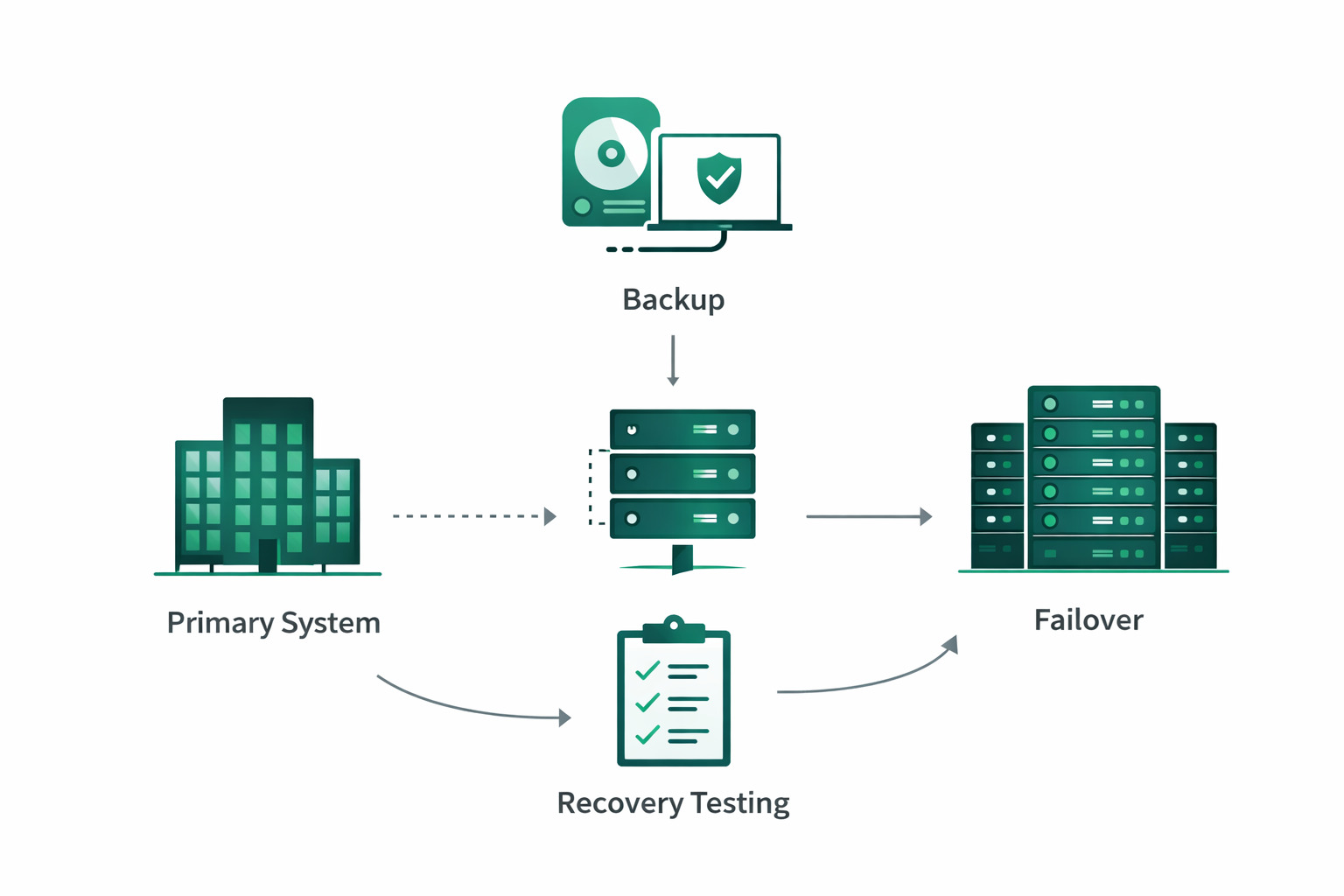
ICT partners typically design layered resilience models:
- Primary production environment
- Secondary failover site
- Cloud-based backup environments
- Automated orchestration
Hybrid cloud disaster recovery models reduce dependency on a single infrastructure provider.
3. Automation and Testing
Recovery plans that are not tested fail in real incidents.
ICT partners implement:
- Automated failover simulations
- Quarterly resilience testing
- Chaos engineering practices
This ensures recovery is executable, not theoretical.
Technology Model - Cloud-Native and Distributed Resilience
Cloud disaster recovery has transformed traditional DR models.
Instead of expensive physical secondary data centers, enterprises now leverage:
- Infrastructure as Code - IaC
- Cross-region cloud replication
- Immutable backups
- Managed detection and response integration
According to McKinsey research on digital resilience, organizations that integrate automation into recovery operations significantly reduce recovery time.
This shift requires architectural expertise. ICT partners bring structured implementation experience across sectors.
Industry Insight - The Cost of Inaction
Industry data consistently highlights the financial exposure of downtime.
Gartner estimates that the average cost of IT downtime can reach thousands of euros per minute for large enterprises.
Meanwhile, the European Union Agency for Cybersecurity - ENISA - emphasizes that ransomware incidents remain one of the primary causes of operational disruption across EU member states.
Regulatory pressure is increasing.
Frameworks such as:
- NIS2 Directive
- ISO 27001
- ISO 22301
Are pushing enterprises toward structured resilience governance.
Business continuity is no longer optional. It is regulatory, financial, and strategic.
Euro IT Sourcing Perspective
From our experience working with European technology-driven organizations, resilience gaps often emerge not from lack of intent but from fragmented ownership.
Infrastructure teams focus on uptime. Security teams focus on threat mitigation. Operations focus on performance.
True business continuity requires orchestration across all three.
We observe that enterprises benefit most when ICT partners:
- Integrate disaster recovery into DevOps pipelines
- Align infrastructure architecture with compliance strategy
- Establish measurable RTO and RPO accountability
Resilience becomes embedded into delivery - not layered on top.
Results - Measurable Impact of Structured ICT Partnerships
Organizations that formalize disaster recovery through ICT partners typically achieve:
- 30 to 50 percent reduction in recovery time
- Improved cross-border regulatory compliance
- Lower infrastructure redundancy costs
- Increased stakeholder confidence
Cloud-driven DR models also enable faster scalability.
In high-growth European markets, this flexibility becomes a competitive advantage.
Resilience shifts from defensive cost to strategic enabler.
Key Takeaways
- Disaster recovery is a board-level responsibility, not just an IT function
- ICT partners enable structured, testable resilience models
- Cloud-native disaster recovery reduces cost while increasing flexibility
- Regulatory frameworks in Europe demand measurable business continuity governance
- Automation and regular testing define real resilience
Author & Contact
Author: Matt Borekci https://www.linkedin.com/in/matt-borekci
Contact Us: https://www.euroitsourcing.com/en/contact
Cyber Insurance in the Age of Outsourced IT: Do You Really Need It?
Learn why cyber insurance matters for companies outsourcing IT services, and how to assess risks, compliance, and business continuity.

Smart-City Projects: Leveraging ICT Partners for Urban Tech
How ICT partners accelerate smart-city projects across Europe with scalable, secure, and cost-efficient urban technology solutions.