FinTech Outsourcing Trends to Watch in 2025
- 1 min read
Explore the top FinTech outsourcing trends in 2025 shaping cost efficiency, innovation, and scalability across European financial services.
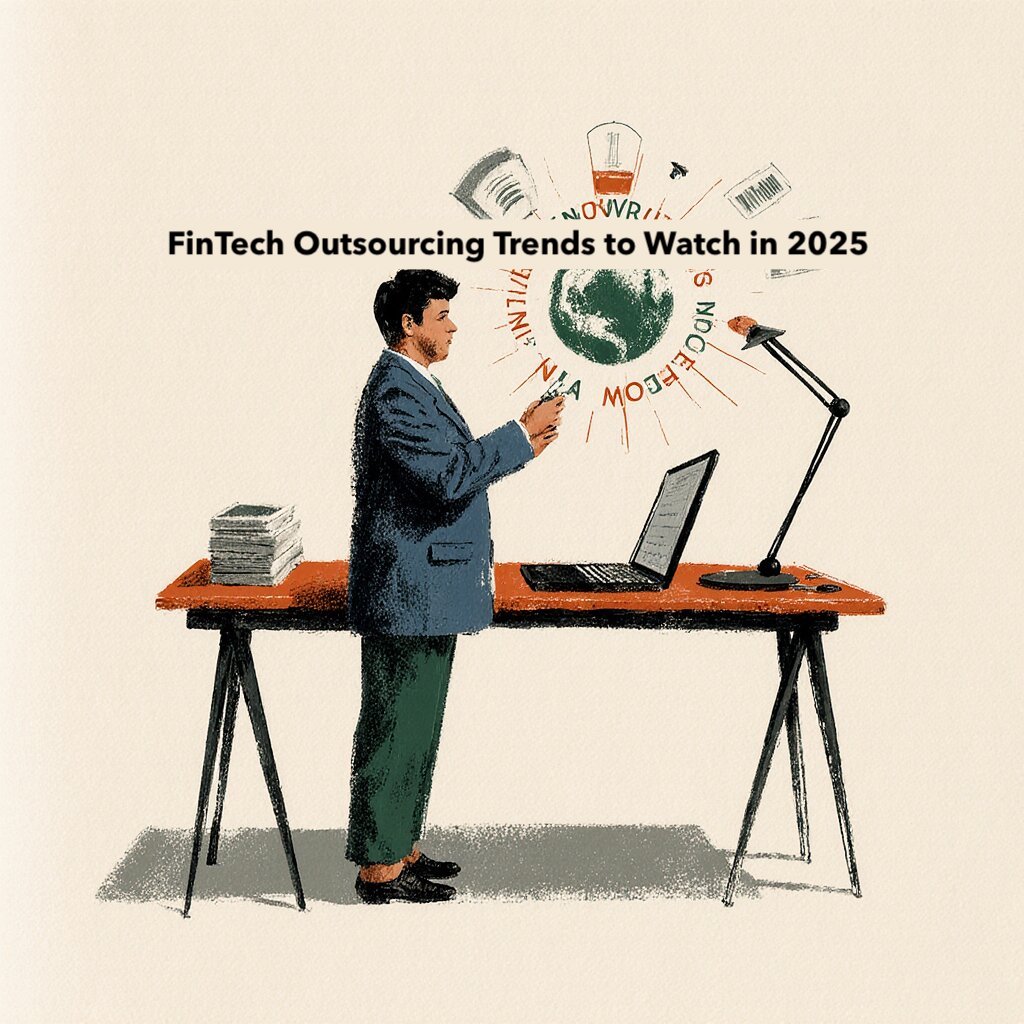
The Shift From Cost Saving to Strategic Leverage
FinTech outsourcing is no longer just about reducing costs. It is becoming a core lever for innovation, scalability, and resilience. In 2025, this shift is especially visible across Europe, where regulatory pressure and digital competition are intensifying.
The European fintech market is projected to grow significantly, driven by digital adoption and regulatory frameworks such as instant payments and open banking. (Mordor Intelligence) At the same time, outsourcing is evolving into a strategic enabler, not just an operational decision.
Organizations that understand this shift are moving faster. Those that do not risk falling behind.
Talent Shortage Is Driving Outsourcing Decisions
One of the most critical drivers of fintech outsourcing in 2025 is talent scarcity.
Across Europe, demand for skilled professionals in AI, cybersecurity, and financial engineering is outpacing supply. Countries like Germany alone require hundreds of thousands of additional skilled workers annually to meet demand. (combinegr.com)
This is pushing companies to:
- Build nearshore and offshore delivery centers
- Partner with specialized fintech development firms
- Access global talent pools instead of relying on local hiring
Outsourcing is no longer optional. It is a necessity for maintaining delivery velocity.
AI-Driven Outsourcing Is Redefining Delivery Models
Artificial intelligence is reshaping how fintech services are built and delivered.
From fraud detection to personalized financial services, AI is now embedded in core fintech operations. Research shows that AI adoption is transforming workflows, automation, and decision-making across financial institutions. (arXiv)
In outsourcing models, this translates to:
- AI-augmented development teams
- Automated testing and compliance monitoring
- Intelligent process automation in financial workflows
The result is not just faster delivery, but smarter systems with continuous learning capabilities.

Rise of Global Capability Centers and Hybrid Models
FinTech companies are increasingly adopting hybrid outsourcing models. These combine internal teams with external delivery centers.
A clear example is the expansion of Global Capability Centers. Major fintech firms are scaling operations in regions like Eastern Europe and India to support engineering, compliance, and operations at scale. (Reuters)
Key advantages include:
- Cost efficiency without sacrificing quality
- 24/7 operational coverage
- Access to specialized domain expertise
This model allows fintechs to remain agile while maintaining control over critical functions.
Compliance and Regulatory Complexity Are Outsourced
European fintech operates within one of the most complex regulatory environments globally.
From PSD2 to emerging frameworks like Financial Data Access (FiDA), compliance requirements are expanding. (gftn.co)
As a result, outsourcing is increasingly focused on:
- Regulatory technology (RegTech) solutions
- Compliance monitoring and reporting
- Data governance and security frameworks
Specialized partners bring not only technical expertise but also regulatory knowledge that is difficult to build internally.
Cloud-Native and API-First Architectures Enable Outsourcing
Modern fintech platforms are built on cloud-native, modular architectures.
These systems are designed for integration and scalability, making them ideal for distributed development models.
Key trends include:
- API-first financial ecosystems
- Microservices-based architectures
- Cloud-native infrastructure for rapid deployment
These technologies reduce dependency on monolithic systems and make outsourcing more seamless and efficient.

Industry Insight
According to KPMG, fintech investment in the EMEA region reached $13.7 billion in the first half of 2025, demonstrating continued momentum despite global uncertainty. (KPMG)
At the same time, reports indicate that fintech revenues are growing significantly faster than traditional financial services, highlighting the sector’s increasing maturity and profitability. (The Economic Times)
This growth is directly influencing outsourcing strategies, as companies seek scalable models to support expansion.
Euro IT Sourcing Perspective
From our experience working with European fintech and financial services organizations, outsourcing success depends on alignment, not just execution.
The most effective partnerships are those where external teams are embedded into the client’s operating model. Not treated as vendors, but as extensions of internal teams.
We also observe a growing preference for nearshore models in Eastern Europe. These offer a strong balance between cost efficiency, cultural alignment, and regulatory familiarity.
Another key pattern is the integration of AI capabilities directly into outsourced teams. This is quickly becoming a baseline expectation rather than a differentiator.
Results and Business Impact
Organizations that adopt modern fintech outsourcing strategies are seeing measurable results:
- Faster time-to-market for digital financial products
- Reduced operational costs through optimized delivery models
- Improved scalability during growth phases
- Enhanced compliance readiness in regulated environments
More importantly, they gain flexibility. The ability to scale teams, adapt to market shifts, and innovate continuously.
Key Takeaways
- FinTech outsourcing is shifting from cost-saving to strategic value creation
- Talent shortages across Europe are accelerating outsourcing adoption
- AI is transforming outsourced delivery models and capabilities
- Hybrid and nearshore models are becoming the dominant approach
- Regulatory complexity is increasing demand for specialized partners
Author & Contact
Author: Matt Borekci https://www.linkedin.com/in/matt-borekci
Contact Us: https://www.euroitsourcing.com/en/contact
Digital Transformation for Banks: The Outsourcing Accelerator
How outsourcing accelerates digital transformation in banking by reducing costs, improving scalability, and enabling faster innovation.

FinTech Outsourcing Trends to Watch in 2026
Discover the top FinTech outsourcing trends for 2026, from AI-driven agents to outcome-based delivery models, shaping the future of European financial services.