Fixed-Price vs. Time-and-Materials: Choosing the Right IT Outsourcing Model for Enterprise Success
- 1 min read
Fixed-Price vs. Time-and-Materials explained for enterprises. Learn which IT outsourcing model reduces risk, improves control, and supports scale.
Why Pricing Models Now Define Delivery Success
In European enterprise IT, pricing models are no longer administrative details. They shape risk, velocity, and innovation capacity.
As digital transformation accelerates, CIOs face pressure to deliver predictable outcomes while maintaining flexibility. The choice between Fixed-Price and Time-and-Materials often determines whether a project scales or stalls.
In complex environments - cloud migrations, AI integration, or platform modernization - the commercial model must align with uncertainty levels. Choosing incorrectly can create friction between procurement and engineering from day one.
The Core Difference Between Fixed-Price and Time-and-Materials
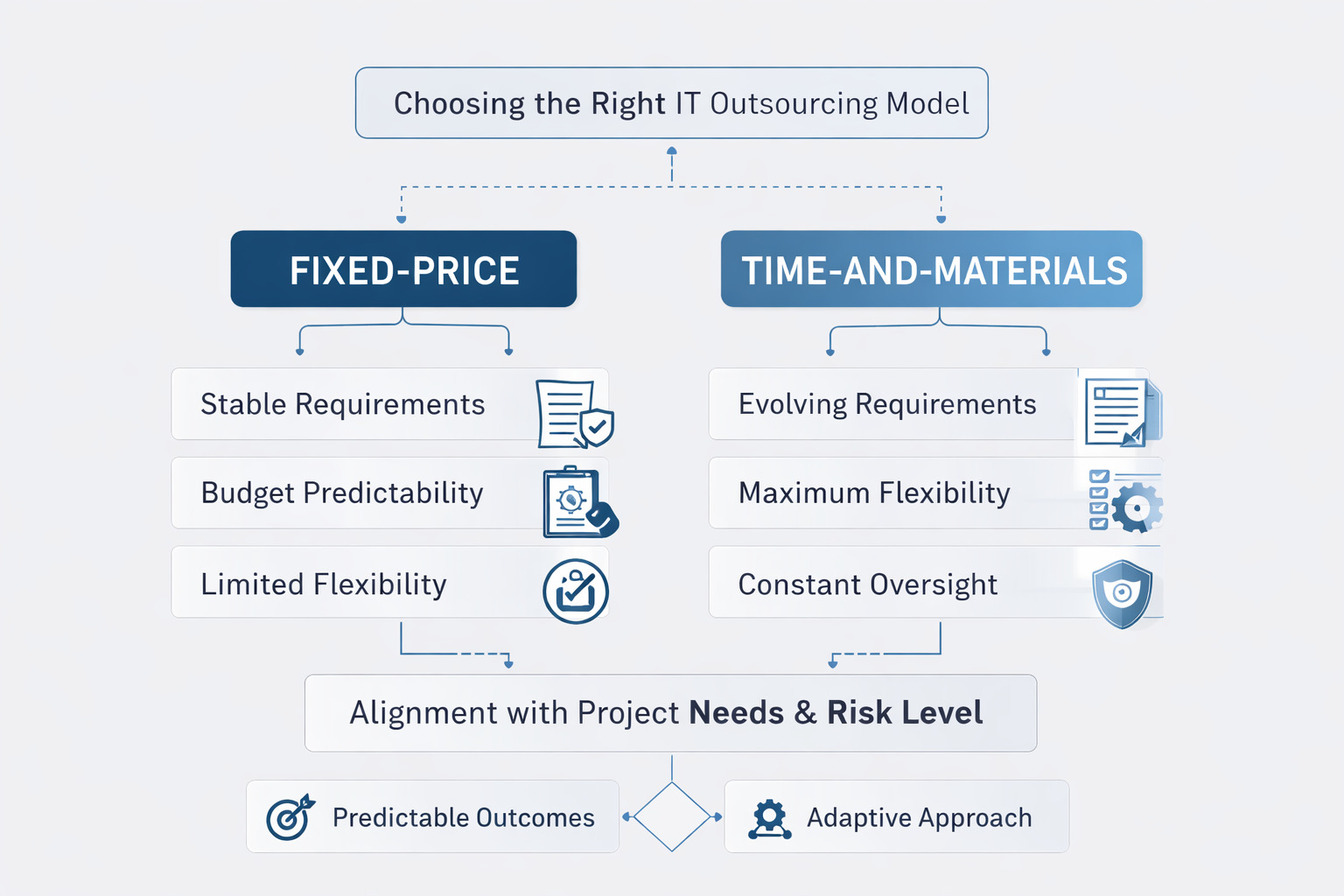
Fixed-Price Model
Under a fixed-price contract, scope, cost, and timeline are defined upfront. The vendor assumes delivery risk within agreed parameters.
Best suited for:
- Clearly defined scope
- Stable requirements
- Compliance-driven projects
- Limited change tolerance
Advantages:
- Budget predictability
- Easier procurement approval
- Clear contractual milestones
Risks:
- Change requests become costly
- Innovation slows if scope is rigid
- Vendor may optimize for margin over agility
Time-and-Materials Model
In a time-and-materials contract, clients pay for actual hours and resources used. Scope evolves as work progresses.
Best suited for:
- Agile product development
- Evolving requirements
- Innovation-driven initiatives
- Long-term collaboration
Advantages:
- Maximum flexibility
- Transparent cost structure
- Faster iteration cycles
Risks:
- Requires strong governance
- Budget can drift without controls
- Demands close stakeholder involvement
According to research from Gartner, agile-aligned commercial models significantly improve digital initiative success rates when requirements are uncertain.
The Strategic Decision Framework
Selecting the right IT outsourcing model depends on three variables:
1. Requirement Stability
- High stability - Fixed-Price works well
- Low stability - Time-and-Materials reduces friction
2. Risk Appetite
- Transfer risk to vendor - Fixed-Price
- Share and manage risk collaboratively - Time-and-Materials
3. Innovation Level
- Operational execution - Fixed-Price
- Product innovation - Time-and-Materials
European enterprises increasingly adopt hybrid models, combining structured milestones with flexible execution layers. McKinsey highlights that adaptive governance improves large-scale transformation outcomes by up to 30 percent.
Delivery Model Implications for European IT Organizations
Regulatory complexity across the EU adds another dimension. Standards from organizations such as NIST and ISO influence how scope, security, and compliance are defined.
- Compliance-heavy sectors - financial services, healthcare - often lean toward Fixed-Price.
- SaaS, AI, and data-driven initiatives typically favor Time-and-Materials.
Procurement leaders must balance commercial safeguards with engineering autonomy. Overly rigid contracts can undermine DevOps maturity and continuous delivery practices.
Industry Insight
Enterprise IT projects continue to struggle with overruns. Studies cited by the European Commission show that digital transformation programs fail to meet objectives at high rates when governance and flexibility are misaligned.
Key insight: Projects fail less due to pricing models themselves and more due to misalignment between model and uncertainty.
Organizations that treat pricing strategy as part of delivery architecture consistently outperform peers.
Euro IT Sourcing Perspective
From our experience working with European technology-driven organizations, the most successful engagements begin with clarity about volatility.
We observe three recurring patterns:
- Stable infrastructure projects perform well under Fixed-Price with defined milestones.
- Product modernization efforts benefit from Time-and-Materials with sprint-based governance.
- Hybrid contracts - structured baseline plus agile extensions - often deliver optimal balance.
The conversation should not be about cost alone. It should focus on alignment between business objectives and delivery dynamics.
Expected Results and Business Impact
When the correct model is chosen:
- Time-to-market improves due to reduced contractual friction
- Cost predictability increases through aligned governance
- Vendor collaboration strengthens
- Operational risk decreases
Benchmarks suggest that properly aligned outsourcing contracts reduce change-order disputes by up to 40 percent and accelerate release cycles significantly.
Enterprises that align commercial structure with agility maturity consistently achieve stronger digital ROI.
Key Takeaways
- Pricing models influence delivery performance, not just cost.
- Fixed-Price fits stability and compliance-heavy environments.
- Time-and-Materials supports agility and innovation.
- Hybrid models often deliver enterprise balance.
- Governance maturity determines success more than contract type.
Author & Contact
Author: Matt Borekci https://www.linkedin.com/in/matt-borekci
Contact Us: https://www.euroitsourcing.com/en/contact
Cybersecurity Risks in IT Outsourcing and How to Mitigate Them
Explore the most common cybersecurity risks in IT outsourcing and discover effective strategies to mitigate them. Learn how to protect your business while leveraging outsourcing advantages.

The Hidden Costs of Outsourcing Security Testing
Uncover the unnoted expenses and risks in outsourcing security testing, and comprehend how to ensure value, transparency, and long-term protection with Euro IT Sourcing.