GenAI Implementation: Real-World Use Cases for Modern Outsourcing
- 1 min read
Explore practical GenAI implementation use cases for modern outsourcing, from software delivery to IT support, governance, and cost optimization.

GenAI Is Moving Outsourcing From Capacity Support to Intelligence-Driven Delivery
Outsourcing has traditionally solved a capacity problem. Enterprises needed more developers, support engineers, testers, analysts, or infrastructure specialists. GenAI implementation changes that equation.
The question is no longer only “Who can deliver the work?” It is also “How intelligently can the work be delivered?” For European enterprises managing complex systems, regulatory expectations, and cost pressure, generative AI outsourcing is becoming a practical route to faster execution and better operational control.
The Challenge: Why Many GenAI Projects Fail After the Pilot
Many enterprises have tested GenAI. Fewer have scaled it.
According to McKinsey’s State of AI 2025 report, most organizations are using AI, but many remain in early stages of scaling and enterprise value capture. Gartner also warned that a significant share of GenAI projects would be abandoned after proof of concept because of unclear business value, weak data quality, rising costs, and insufficient risk controls.
Common barriers include:
- Poorly defined use cases
- Limited access to reliable enterprise data
- Weak integration with existing systems
- Lack of ownership between client and provider
- Security, privacy, and compliance concerns
- No clear measurement model
For CIOs and procurement leaders, the risk is not experimenting with GenAI. The real risk is funding disconnected experiments that never improve delivery performance.

Real-World Use Case 1: AI-Assisted Software Development
Software development is one of the most mature areas for GenAI implementation in modern outsourcing.
AI-assisted development can support:
- Code suggestions
- Unit test generation
- Code review preparation
- Legacy code explanation
- Documentation drafting
- Refactoring recommendations
- Developer onboarding
The value is not simply faster coding. The bigger impact is consistency. Distributed development teams can reduce time spent on repetitive tasks and improve knowledge transfer across projects.
For example, when a new outsourced developer joins a legacy enterprise application, GenAI can summarize modules, explain dependencies, and generate onboarding documentation. This reduces ramp-up time and lowers dependency on a few senior engineers.
However, AI-generated code must never bypass engineering governance. Secure code review, human validation, and repository controls remain essential.
Real-World Use Case 2: IT Support and Service Desk Automation
IT support is another high-impact area for GenAI in outsourcing.
Service desk teams manage repetitive tickets, fragmented knowledge bases, and user requests with varying levels of urgency. GenAI can improve first-line support by helping agents respond faster and more accurately.
Relevant use cases include:
- Ticket classification
- Suggested responses
- Knowledge base recommendations
- Incident summaries
- Root cause analysis support
- Automated status updates
- Multilingual support responses
For European organizations operating across multiple countries, multilingual support is especially valuable. GenAI can help standardize support quality while reducing language barriers.
The goal is not to remove human agents from the process. It is to help them resolve issues faster, escalate better, and maintain more consistent service quality.
Real-World Use Case 3: Documentation and Knowledge Management
Enterprise IT environments generate large volumes of documentation. Much of it becomes outdated quickly.
In outsourced delivery models, documentation quality directly affects continuity, compliance, and operational resilience. GenAI can support documentation in several ways:
-
Creating release notes from technical updates

-
Summarizing project decisions
-
Drafting technical documentation
-
Converting meeting notes into action items
-
Translating documentation for distributed teams
-
Identifying outdated knowledge base content
This is a practical use case because the output can be reviewed before publication. It also addresses a persistent outsourcing challenge: knowledge loss when teams change.
Strong documentation reduces dependency on individuals. It makes delivery more scalable and easier to audit.
Technology and Delivery Model: Human-in-the-Loop by Design
The most reliable GenAI outsourcing models are not fully automated. They are human-in-the-loop.
This means AI supports the delivery team, but accountable professionals validate the output. This is especially important in enterprise IT, where errors can create operational, financial, or regulatory risk.
A responsible delivery model should define:
- Which tasks AI can support
- Which outputs require human review
- Which data sources AI can access
- How prompts and outputs are logged
- How quality is measured
- Who is accountable for final decisions
The NIST AI Risk Management Framework provides a useful reference for managing AI-related risks. The NIST Generative AI Profile also emphasizes trustworthiness considerations for GenAI systems.
For European organizations, the regulatory context also matters. The European Commission’s guidance on General-Purpose AI Code of Practice highlights transparency, copyright, safety, and security obligations linked to the EU AI Act.
Risks and Trade-Offs: What Enterprises Must Control
GenAI implementation introduces real benefits. It also creates new risk categories.
The most important risks include:
- Data leakage through unapproved tools
- Inaccurate or hallucinated outputs
- Over-reliance on AI-generated work
- Intellectual property uncertainty
- Security gaps in code generation
- Lack of auditability
- Vendor lock-in
- Hidden operational costs
These risks are manageable, but only when they are addressed early.
Enterprises should avoid informal GenAI usage across outsourced teams. Instead, they should define an approved AI operating model. This includes tool selection, data classification, review rules, and measurable performance standards.
In outsourcing, governance should be contractual as well as operational. AI usage expectations should be visible in delivery agreements, security policies, and reporting structures.
Industry Insight: The Value Gap Is Now the Central AI Problem
The market has moved past curiosity. Most enterprises now understand that GenAI can improve productivity. The harder question is how to capture value consistently.
McKinsey’s 2025 research shows broad AI adoption, but also highlights that many organizations are still working to scale AI and capture enterprise-level impact. Gartner’s warning about abandoned GenAI projects points to the same issue: experimentation is easier than operationalizat
 ion.
ion.
This creates an important lesson for outsourcing leaders.
GenAI value does not come from adding AI tools to an existing delivery model. It comes from redesigning workflows around measurable outcomes. That includes faster delivery cycles, better documentation, stronger support resolution, improved test coverage, and clearer management reporting.
The winners will be organizations that treat GenAI as a delivery capability, not a side experiment.
Euro IT Sourcing Perspective
From our experience working with European technology-driven organizations, the most successful outsourcing relationships are built around clarity. Clear scope. Clear communication. Clear accountability. GenAI does not remove that need. It increases it.
We see a growing pattern across enterprise IT teams. Clients do not simply want more capacity. They want delivery partners who can help improve how work gets done. That includes smarter documentation, faster onboarding, better reporting, and more structured knowledge transfer.
For Euro IT Sourcing, the practical value of GenAI lies in disciplined implementation. The technology must support the team, the process, and the business objective. It should not create another layer of complexity.
Key Takeaways
- Start with high-friction workflows, not with AI tools.
- Use GenAI where human review is practical and value is measurable.
- Prioritize software delivery, IT support, QA, documentation, and procurement intelligence.
- Build governance into the outsourcing model from the beginning.
- Treat GenAI as a delivery capability, not a standalone experiment.
Author & Contact
Author: Matt Borekci https://www.linkedin.com/in/matt-borekci
Contact Us: https://www.euroitsourcing.com/en/contact

The Impact of AI Tools on IT Workforce and Outsourcing Business
AI tools are revolutionizing the IT workforce and outsourcing industry by enhancing productivity and reshaping traditional models. In software development, tools like GitHub Copilot and Jira streamline coding and project management, allowing workers to be more efficient. As AI augments skill sets, businesses are increasingly seeking skilled professionals from regions like Eastern Europe, offering a balance of quality and cost-effectiveness. While India remains a key player in outsourcing, the rise of AI makes other markets, particularly in Eastern Europe and emerging regions, more competitive. This evolution promises to further reshape global outsourcing dynamics in the coming years.
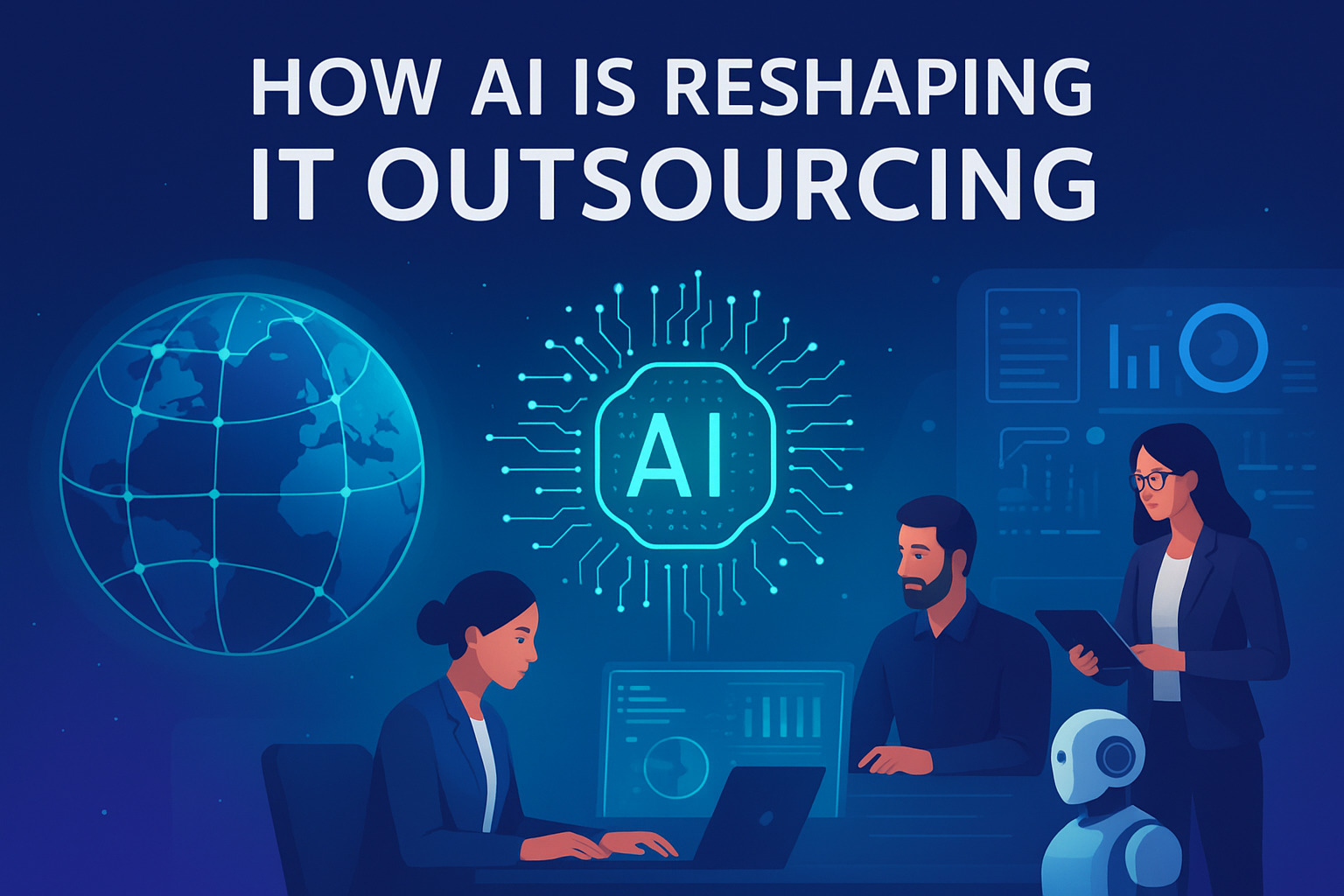
How AI is Reshaping IT Outsourcing: From Cost Savings to Strategic Advantage
Discover how AI is transforming IT outsourcing—driving efficiency, reducing costs, and enabling companies to focus on strategic growth.