Gold: Why It Still Matters in 2026
- 1 min read
Why gold remains valuable in 2026: history, fair value, central bank strategy, and whether gold is still a smart store of value today.
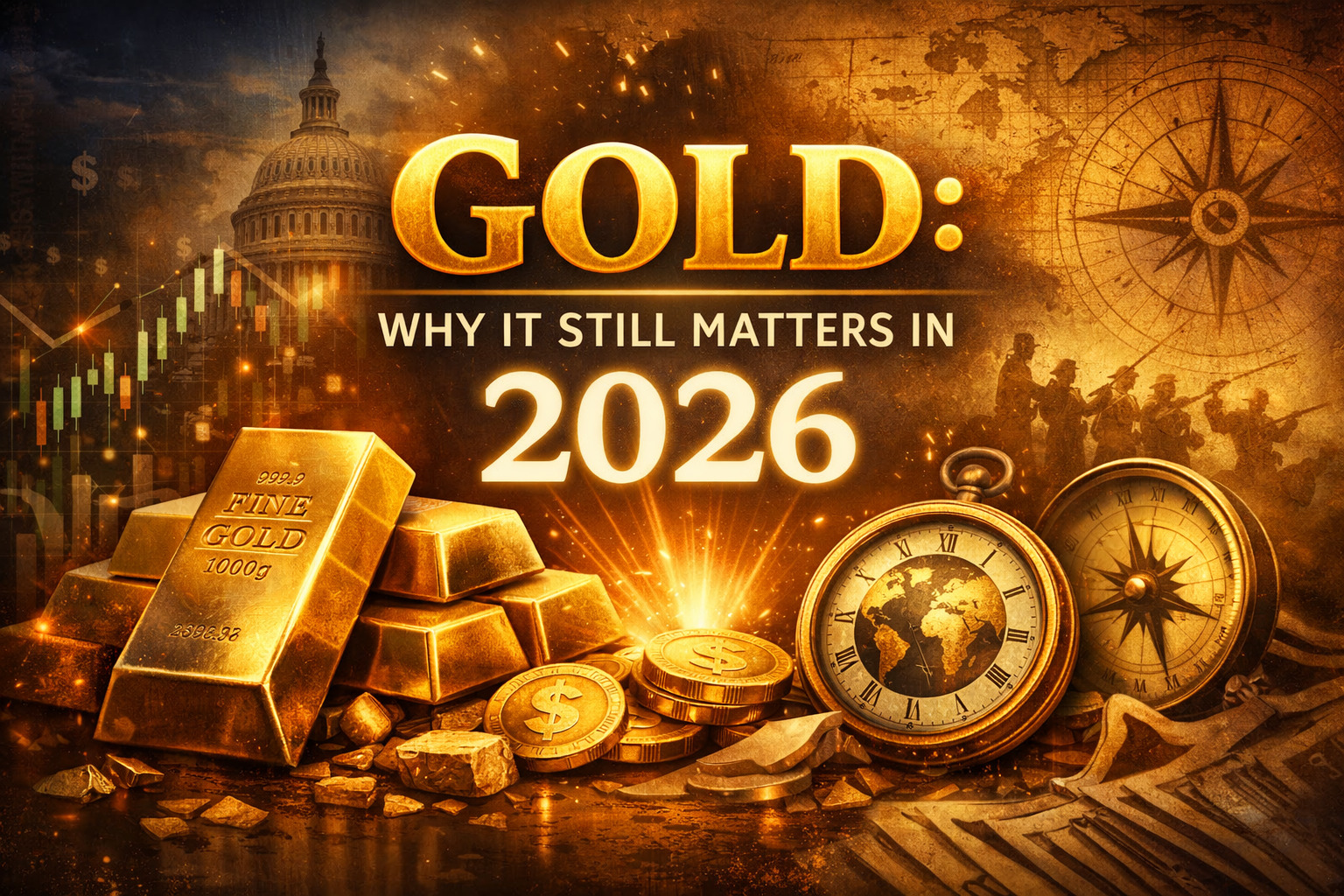
Value, Power, and the Psychology Behind the World’s Oldest Store of Wealth
Introduction
Last week’s sharp surge in gold prices revived a familiar set of questions: What is gold, really? Why is it valuable? And why does it continue to matter in a world dominated by digital finance, cryptocurrencies, and fiat money?
For thousands of years, gold has functioned as a store of value for humanity. Long before fiat currencies existed, wealth was measured in tangible assets—chief among them gold. Even early banknotes in the United States were not money in the modern sense, but certificates issued by bankers representing gold deposited in vaults. Those certificates eventually evolved into today’s fiat currencies, backed not by gold itself, but by trust in governments and institutions.
Despite centuries of financial innovation, gold remains embedded in the global financial system. Central banks still hold it. Investors still rush toward it during crises. And governments still quietly maneuver around it. To understand why, we need to go back to first principles.
Part 1: Why Gold?
The Accidental King of Money
From a purely functional standpoint, gold is not a particularly useful metal. It is soft, not structurally durable, and unsuitable for construction, armor, or weapons. It is not the best conductor, the hardest element, or the most practical industrial material.
And yet, gold won.
Why?
1. Technological Accessibility
In ancient and medieval times, humanity lacked the technical capability to process metals like tungsten, titanium, or advanced steel alloys. Gold, however, has a relatively low melting point and could be worked using simple tools and furnaces available thousands of years ago. This made gold processable long before most other metals.
2. Scarcity Without Obscurity
Gold is rare—but not too rare. Iron and copper are abundant, which disqualifies them as long-term value anchors. On the other end of the spectrum, hypothetical or extremely scarce materials (think of fictional metals like adamantium) would be too rare to circulate or be socially recognized.
Gold sits perfectly in the middle:
- Rare enough to resist inflation
- Common enough to be widely known, recognized, and trusted

3. Durability and Stability
Gold does not rust, corrode, or decay. A gold coin buried for 2,000 years can be recovered looking nearly identical to the day it was minted. This physical permanence helped establish gold as a multi-generational store of value.
4. Divisibility and Uniformity
Gold can be melted, divided, and reformed without losing value. One ounce of gold is chemically identical to any other ounce of gold. This made it ideal for trade, taxation, and standardization long before modern accounting systems existed.
5. Psychological and Cultural Momentum
Perhaps most importantly, gold became valuable because people collectively agreed that it was valuable—and never stopped believing it. Over centuries, gold embedded itself into culture, religion, power structures, and psychology. Once that belief loop formed, it became self-reinforcing.
Gold did not win because it was perfect. Gold won because it was good enough early—and trusted forever.
Part 2: Strategic Cycles and “Retail Shakeouts”
(Let’s Call It What It Is)
Large economies like the United States naturally carry large external debts. That alone is not unusual. What is interesting, however, is that the U.S. also holds one of the largest gold reserves in the world.
This raises an uncomfortable—but reasonable—question:
Could a government intentionally allow or even encourage gold prices to rise, sell gold at elevated levels, manage debt pressure, and later reaccumulate gold once prices cool and the dollar strengthens again?
Before labeling this a conspiracy theory, consider the mechanics.

How This Could Work (Technically)
- Gold is priced globally in U.S. dollars
- A weaker dollar typically pushes gold prices higher
- Central banks can influence liquidity, rates, and currency strength
- Gold demand often spikes during fear-driven retail inflows
Once retail demand peaks and sentiment becomes euphoric, prices tend to correct. At that point:
- Stronger currencies regain purchasing power
- Gold prices soften
- Large institutions can re-enter at lower levels
This cycle—sometimes called a liquidity-driven redistribution—has appeared repeatedly throughout financial history. Retail investors often enter near peaks, while institutions operate on longer, more patient timelines.
Is this manipulation? Not necessarily.
Is it strategic? Almost certainly.
Part 3: Does Gold Have a “Fair Value”?
Yes—and No
So if gold can be strategically pushed around, does it still have intrinsic value?
Absolutely.
The Concept of Fair Price
Gold’s fair value is often evaluated using several indicators, including:
- Real interest rates (nominal rates minus inflation)
- Money supply growth (M2 expansion)
- Purchasing power parity over time
- Gold-to-equity or gold-to-oil ratios
When real yields are negative and money supply expands aggressively, gold historically trends higher. These conditions increase the opportunity cost of holding fiat currencies and make gold more attractive as a hedge.
Crisis Utility
Unlike real estate or businesses, gold is:
- Portable
- Globally recognized
- Independent of any single government
During wars, mass migration, political collapse, or banking freezes, gold demand rises sharply—not because it yields income, but because it survives chaos.
Gold is not about growth. Gold is about continuity.
Part 4: Gold Is Valuable—But Balance Matters
This Is Not Investment Advice (But It Is Common Sense)
Gold will likely remain valuable for as long as uncertainty exists—which is to say, indefinitely. However, financial wisdom teaches a timeless rule:
Never put all your eggs in one basket.
Gold protects against specific risks—currency debasement, systemic crises, geopolitical instability—but it does not generate cash flow, innovation, or productivity. A balanced portfolio spreads risk across:
- Precious metals
- Equities
- Real assets
- Human capital
- Businesses and skills
Risk optimization is not about predicting the future perfectly. It is about not being wrong in only one direction.
Part 5: Missed the Gold Train?
There’s Another One at the Platform 😉
Yes, gold may already have rallied. Yes, you might feel late to the party.
But while gold prices have revalued significantly, Eastern European software talent hasn’t—at least not yet.
High-quality, young, highly motivated developers from Eastern Europe remain one of the most underpriced assets in the global tech economy. No hype cycles. No speculative bubbles. Just real productivity.
If you’re building a product, scaling a team, or launching a project, this might be the opportunity you haven’t missed yet.
📌 Gold may preserve value. Great developers create it.
Get in touch with us while the price is still rational—and let’s get your project done.
Author and Contact
Author: Matt Borekci Contact Us: Euro IT Sourcing

Turkish Tech Renaissance: The Remarkable Growth of the IT Industry
Turkey's IT industry is rapidly growing, driven by its strategic geographic location, a young and educated workforce, and strong government support. The country's thriving startup ecosystem, emphasis on digital transformation, and increasing IT exports are positioning Turkey as a significant player in the global technology landscape. This growth trajectory highlights Turkey's potential and ambition in shaping the future of technology both domestically and internationally.

TURKIYE: The Rising Star of IT Outsourcing
Turkey is quickly becoming a key player in the IT outsourcing industry, thanks to its strategic location, skilled workforce, and cost-effective solutions. Positioned between Europe and Asia, Turkey offers businesses access to top-tier IT talent at competitive prices, with minimal language and cultural barriers. The country's commitment to data protection and innovation further enhances its appeal as a reliable and cutting-edge IT outsourcing partner.