How Mid-Sized Companies Can Access Enterprise-Level Cyber Security Expertise
- 1 min read
Discover how mid-sized companies can access enterprise-level cyber security expertise through strategic outsourcing and modern security models.
Enterprise-Grade Security Is No Longer Optional
Cyber threats no longer discriminate by company size.
Mid-sized organizations across Europe are increasingly targeted because they combine valuable data with comparatively limited security maturity. According to the European Union Agency for Cybersecurity, ransomware and supply chain attacks continue to rise across the region.
At the same time, regulatory pressure under GDPR and sector-specific standards increases accountability. Security failures now impact brand trust, operational continuity, and board-level risk exposure.
Enterprise-level cyber security expertise is no longer a luxury. It is infrastructure.
The Challenge: Limited Internal Capacity, Expanding Threat Surface
Mid-sized companies face a structural gap.
They must defend against the same advanced threats as large enterprises, but without:
- 24-7 Security Operations Centers
- Dedicated threat intelligence teams
- In-house compliance specialists
- Large cyber security budgets
Frameworks such as the National Institute of Standards and Technology Cybersecurity Framework outline comprehensive controls. However, implementing them internally requires deep expertise and continuous monitoring.
The result is often fragmented security tooling. Reactive responses. And elevated operational risk.
The Strategic Approach: Accessing Expertise Without Building It All In-House
Mid-sized organizations do not need to replicate enterprise security structures. They need access to them.
Three models are particularly effective:
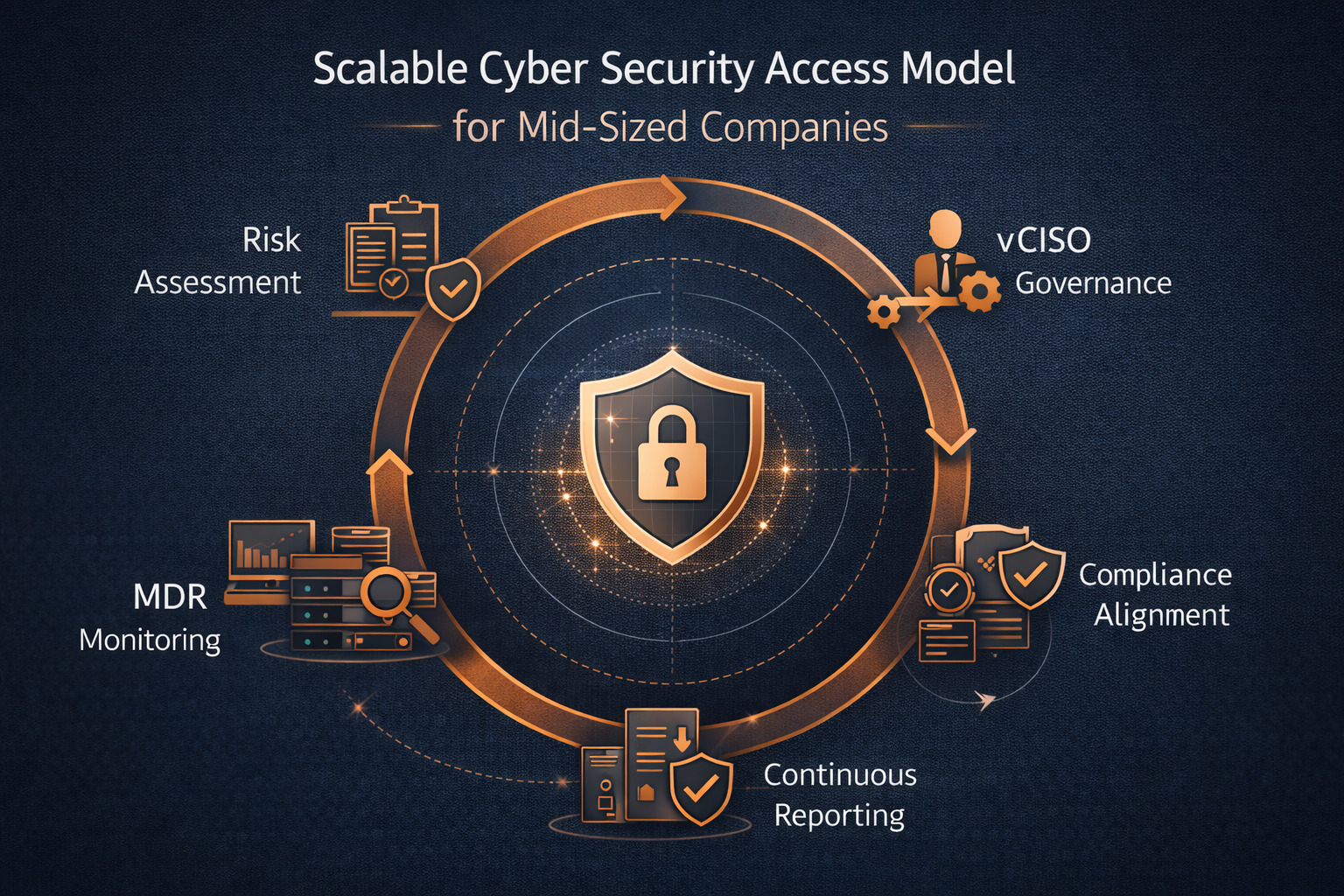
1. Managed Detection and Response - MDR
MDR providers deliver:
- Continuous threat monitoring
- Incident response expertise
- Behavioral analytics
- Threat hunting capabilities
This model provides enterprise-grade visibility without building a full SOC.
2. SOC as a Service
Security Operations Center capabilities can be consumed as a scalable service. This includes:
- Centralized log management
- SIEM optimization
- 24-7 monitoring
- Escalation protocols
3. Virtual CISO - vCISO
A vCISO provides executive-level security leadership without a full-time hire. This ensures:
- Risk governance alignment
- Regulatory compliance roadmap
- Board-level reporting
- Security investment prioritization
These models enable strategic coverage rather than tactical patching.
Aligning with Global Standards and EU Regulations
Enterprise-level security expertise is anchored in recognized standards.
For example:
- International Organization for Standardization ISO 27001 for information security management
- European Union Agency for Cybersecurity ENISA threat landscape reporting
- Gartner guidance on security operations maturity
Mid-sized companies benefit from partners already certified and aligned with these frameworks.
This reduces audit friction. It strengthens stakeholder confidence. It accelerates compliance readiness.
The Delivery Model: Integrated Yet Scalable
Effective access to enterprise-level expertise requires integration.
Best practice models include:
- Security architecture assessment
- Gap analysis against NIST or ISO controls
- Prioritized remediation roadmap
- Continuous monitoring and reporting
- Executive-level risk dashboards
Security partners should integrate with existing IT teams rather than replace them.
The objective is maturity uplift. Not dependency.
Industry Insight
According to multiple European cyber security studies, average ransomware recovery costs for mid-sized firms can reach millions of euros when factoring downtime and remediation.
Additionally, research referenced by McKinsey & Company highlights that cyber resilience is increasingly viewed as a strategic enabler rather than a compliance burden.
Investments in structured security governance correlate with reduced incident impact and faster recovery times.
The economic argument is clear: prevention is more predictable than disruption.
Euro IT Sourcing Perspective
From our experience working with European mid-sized organizations, the most successful security transformations follow a phased model.
We consistently observe that:
- Leadership alignment accelerates decision-making.
- External expertise reduces blind spots in risk assessment.
- Structured frameworks create measurable progress.
Enterprise-level cyber security does not require enterprise headcount. It requires enterprise methodology.
The shift is from isolated tools to coordinated defense.
Results and Business Impact
When mid-sized companies access enterprise-level cyber security expertise, measurable outcomes typically include:
- Reduced mean time to detect and respond to threats
- Improved audit readiness under ISO 27001 and GDPR
- Lower probability of successful ransomware attacks
- Stronger stakeholder and investor confidence
- Predictable security budgeting
Security maturity becomes a competitive differentiator.
Key Takeaways
- Mid-sized companies face enterprise-level threats and regulatory scrutiny.
- Outsourced models such as MDR and SOC as a Service provide scalable expertise.
- Alignment with NIST and ISO frameworks strengthens governance.
- Executive-level oversight through vCISO roles reduces strategic risk.
- Cyber security investment should be structured as risk management, not IT overhead.
Author & Contact
Author: Matt Borekci https://www.linkedin.com/in/matt-borekci
Contact Us: https://www.euroitsourcing.com/en/contact
What Does a Cyber Security Expert Do? A Complete Guide
Discover what a cyber security expert does, their roles, skills, and how they protect businesses from digital threats.
How Much Does a Cyber Security Expert Earn? Salary Insights for 2025
Explore 2025 cybersecurity salary trends, including global averages, roles in demand, and how outsourcing impacts IT security hiring.