Managing IP & Confidentiality in Outsourced Projects
- 1 min read
Learn how to manage IP and confidentiality in outsourced projects with proven governance, contracts, and security frameworks.
Why IP Risk Is the Hidden Cost of Outsourcing
Outsourcing accelerates innovation. It reduces time-to-market. It unlocks global talent.
But without structured IP protection and confidentiality controls, it introduces material risk.
European enterprises operate under strict regulatory frameworks. Data sovereignty, contractual clarity, and IP ownership are board-level concerns. In cross-border IT outsourcing, ambiguity is not a minor oversight. It is a strategic liability.
Managing IP in outsourced projects is no longer a legal afterthought. It is a core pillar of digital transformation governance.
The Challenge: Distributed Delivery, Centralized Risk
Outsourced software development often spans jurisdictions. Multiple teams contribute to code, architecture, documentation, and data handling.
Common risks include:
- Unclear ownership of source code and derivatives
- Weak NDA enforcement across subcontractors
- Improper handling of proprietary algorithms
- Shadow repositories and access sprawl
- Misalignment between contractual terms and technical execution
According to the European Union Agency for Cybersecurity - ENISA, supply chain exposure remains one of the fastest-growing enterprise risks.
When IP protection is fragmented, competitive advantage erodes silently.
The Strategic Approach: Legal, Technical, and Operational Alignment
Effective IP management requires alignment across three layers.
1. Contractual Foundation
Strong contracts establish clarity before development begins.
Key clauses include:
- Explicit IP ownership assignment
- Work-for-hire definitions
- Clear licensing terms
- Confidentiality obligations with defined scope
- Subcontractor compliance requirements
- Jurisdiction and dispute resolution clarity
Standards such as ISO 27001 provide guidance on information security management practices that reinforce contractual commitments.
Legal precision is the baseline. Execution discipline is the differentiator.
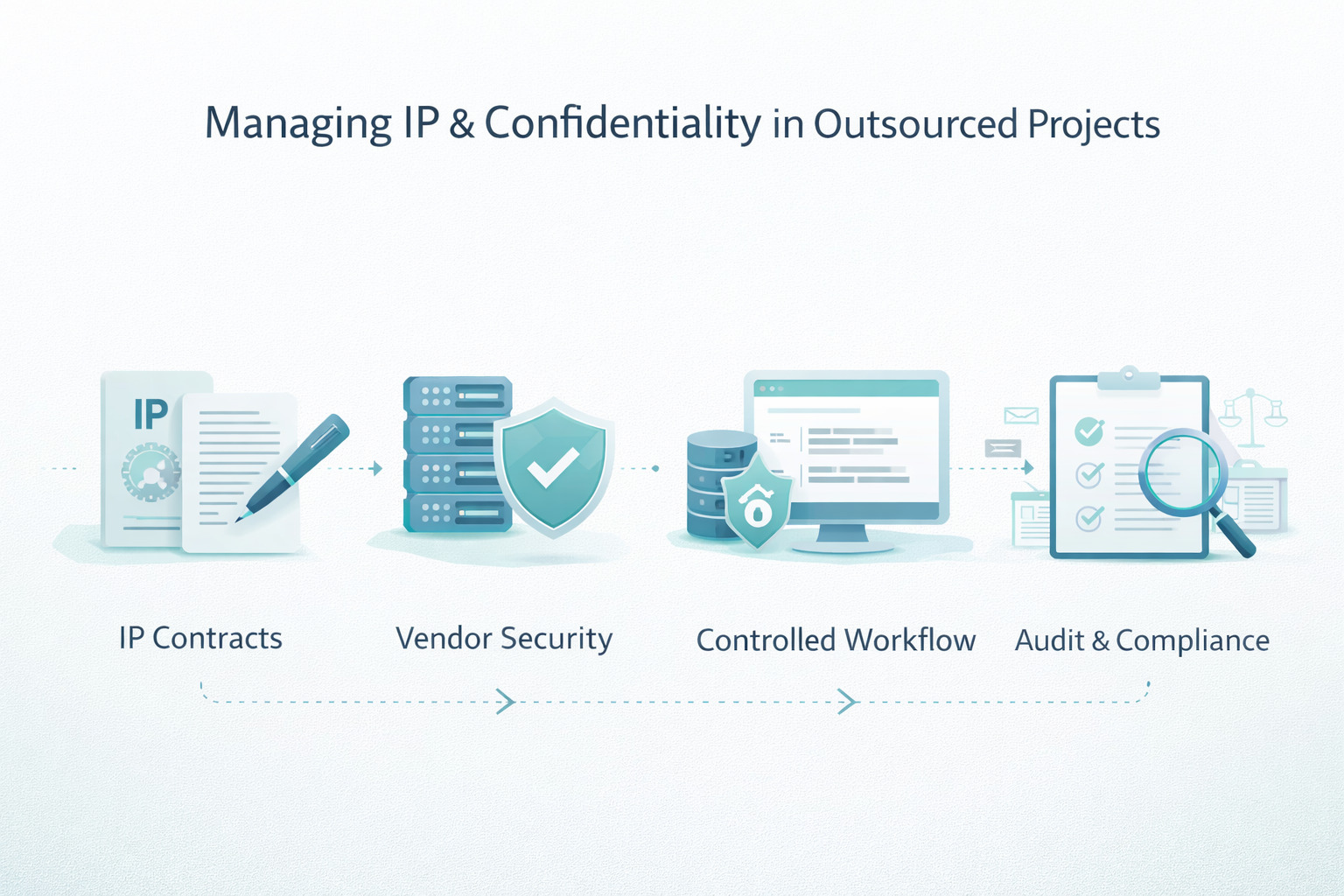
2. Technical Safeguards
Legal language alone does not prevent leakage.
Modern IP governance integrates:
- Role-based access control
- Zero-trust architecture principles
- Secure repository management
- Code ownership tracking
- Encrypted collaboration tools
- Audit logs and activity monitoring
Frameworks like the NIST Cybersecurity Framework emphasize continuous monitoring and risk-based security implementation.
Security architecture must match contractual intent.
3. Operational Governance
Governance bridges policy and execution.
Best practices include:
- Centralized repository ownership under the client organization
- Mandatory IP training for external teams
- Structured onboarding and offboarding processes
- Periodic compliance audits
- Clear data classification policies
McKinsey research on digital risk highlights that organizations integrating cybersecurity governance into business processes significantly reduce breach impact.
IP governance must operate as an ongoing system, not a document archive.
The Delivery Model: Secure-by-Design Outsourcing
In mature outsourcing environments, IP protection is embedded in delivery architecture.
This includes:
- Client-controlled Git environments
- Segmented development environments
- Restricted production access
- Automated compliance checks
- Continuous vulnerability scanning
Secure-by-design delivery reduces reliance on reactive enforcement. It builds structural resilience into outsourced development.
Risks and Trade-offs
Outsourcing does not inherently weaken IP protection. Poor governance does.
However, trade-offs exist:
- Increased compliance oversight costs
- Slower onboarding if controls are strict
- Cross-border regulatory complexity
- Dependence on vendor security maturity
Enterprises must balance speed and control. In regulated European industries, control typically prevails.
Industry Insight
According to Gartner, third-party risk management remains a top priority for CIOs as digital ecosystems expand. Supply chain attacks continue to increase in both sophistication and impact.
ENISA reports emphasize that vendor-related vulnerabilities are a major contributor to systemic digital risk in the EU.
The trend is clear. IP and confidentiality risks are not isolated technical issues. They are ecosystem-level governance challenges.
Organizations that embed security frameworks such as ISO 27001 and NIST principles into outsourcing relationships demonstrate stronger resilience and audit readiness.
Euro IT Sourcing Perspective
From our experience working with European technology-driven organizations, the most successful outsourced projects share a common trait.
IP ownership is never ambiguous.
We observe that high-performing enterprises:
- Maintain architectural control internally
- Centralize repositories under client governance
- Implement strict access lifecycle management
- Integrate legal and technical teams early
The conversation shifts from trust to transparency. From assumption to verification.
IP management becomes part of operational design, not post-contract negotiation.
Results and Impact
When IP and confidentiality governance is structured effectively, enterprises typically achieve:
- Reduced legal exposure
- Faster audit cycles
- Improved regulatory compliance
- Stronger investor confidence
- Lower probability of supply chain disruption
Secure outsourcing also enhances scalability. Organizations expand engineering capacity without expanding risk proportionally.
In measurable terms, mature governance frameworks can reduce incident response costs and breach likelihood while accelerating product development.
Key Takeaways
- IP ownership must be contractually explicit and technically enforced
- Confidentiality controls should extend to subcontractors and tooling environments
- Secure-by-design architecture reduces downstream legal and operational risk
- Governance is continuous, not one-time
- In European IT environments, compliance alignment is a competitive advantage
Author & Contact
Author: Matt Borekci https://www.linkedin.com/in/matt-borekci
Contact Us: https://www.euroitsourcing.com/en/contact
Cybersecurity Risks in IT Outsourcing and How to Mitigate Them
Explore the most common cybersecurity risks in IT outsourcing and discover effective strategies to mitigate them. Learn how to protect your business while leveraging outsourcing advantages.
The Hidden Costs of Outsourcing Security Testing
Uncover the unnoted expenses and risks in outsourcing security testing, and comprehend how to ensure value, transparency, and long-term protection with Euro IT Sourcing.