Measuring ROI in ICT Outsourcing Engagements
- 1 min read
Learn how to measure ROI in ICT outsourcing with practical metrics, cost models, and performance benchmarks for data driven sourcing decisions.

Introduction
Measuring ROI in ICT outsourcing engagements is no longer optional for modern enterprises. CTOs and CIOs are under constant pressure to justify technology spend while maintaining delivery speed and quality. Outsourcing can unlock major value, but only when outcomes are measured correctly.
Many organizations still evaluate outsourcing success using cost reduction alone. That approach is outdated. Today, ROI must include productivity gains, delivery acceleration, risk reduction, and innovation capacity.
With growing adoption of distributed delivery models and nearshore partnerships, companies working with firms like Euro IT Sourcing increasingly focus on value based sourcing metrics, not just hourly rates.
The Challenge: Why ICT Outsourcing ROI Is Hard to Measure
ROI in ICT outsourcing is complex because benefits are both financial and operational.
Common measurement gaps include:
- Focusing only on vendor cost instead of total cost of ownership
- Ignoring transition and knowledge transfer overhead
- Not tracking productivity improvements
- Missing quality and defect reduction metrics
- Lack of baseline performance data before outsourcing
Hidden cost factors often include:
- Internal vendor management effort
- Integration delays
- Security and compliance controls
- Tooling and infrastructure duplication
Without a structured framework, ROI calculations become subjective.
The Approach: A Practical ROI Framework
A reliable ROI model should combine cost, performance, and strategic value indicators.
Core ROI formula:
- ROI = (Total Value Delivered - Total Engagement Cost) / Total Engagement Cost
Value delivered should include:
- Direct cost savings
- Productivity uplift
- Faster time to market
- Reduced operational risk
- Scalability benefits
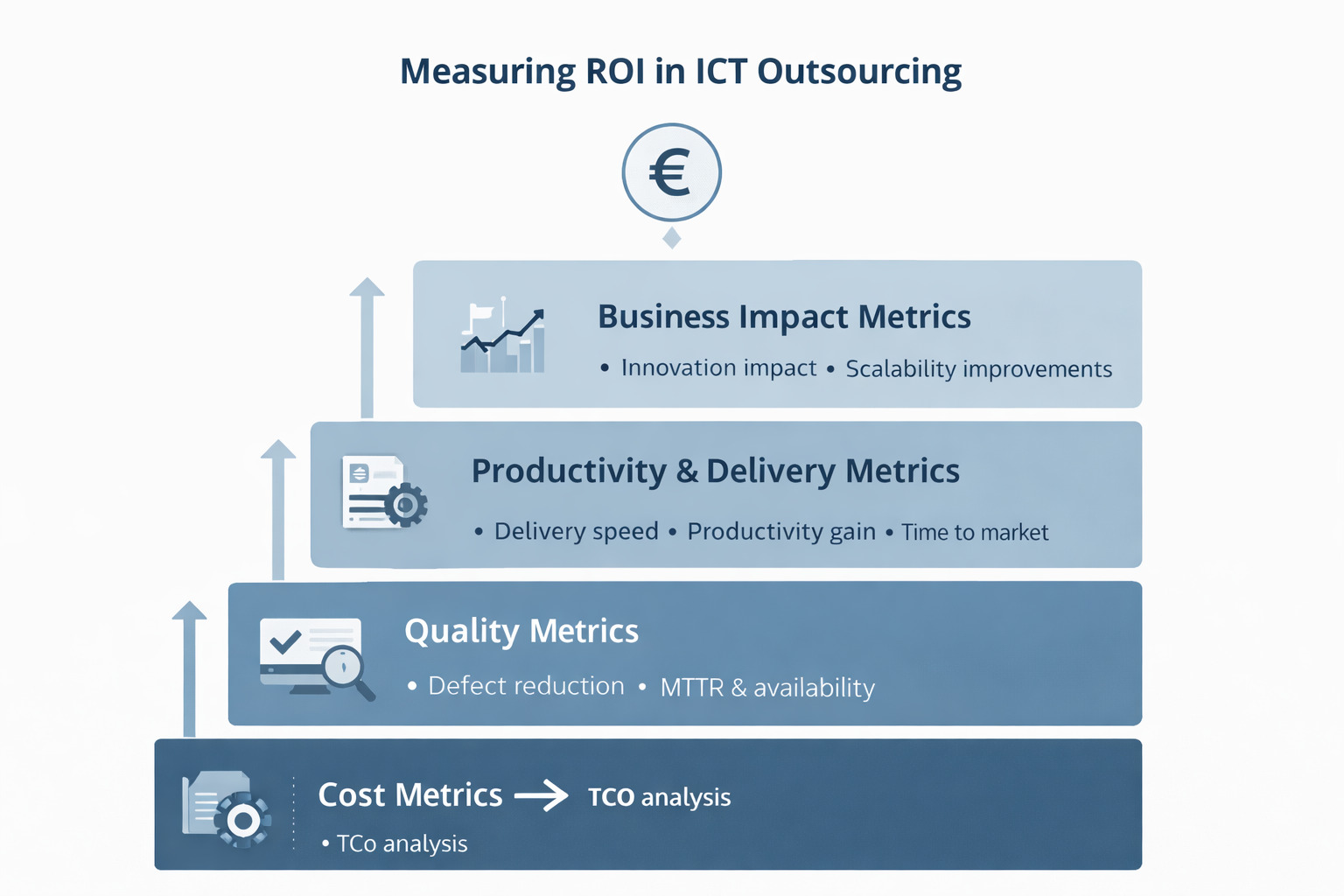
Recommended measurement layers:
- Financial metrics
- Delivery metrics
- Quality metrics
- Business impact metrics
The US National Institute of Standards and Technology provides structured measurement approaches for IT performance and cost modeling that can be adapted for outsourcing analysis: https://www.nist.gov
The Technology Factor: Metrics That Actually Matter
Modern ICT outsourcing must be measured with engineering and delivery KPIs, not only budget KPIs.
Useful performance indicators:
- Feature delivery velocity per sprint
- Cost per delivered feature or story point
- Defect density trends
- Mean time to resolution
- Release cycle duration
- Infrastructure cost per workload unit
Operational indicators:
- Automation coverage percentage
- Deployment frequency
- Incident recurrence rate
- Service availability levels
ISO service management standards also support structured service value measurement practices: https://www.iso.org/standard/81896.html
Industry Insight
Industry research consistently shows that outsourcing ROI improves when engagements are outcome driven rather than resource driven.
Key market observations from global consulting reports:
- Mature sourcing organizations measure business outcomes, not activity levels
- Hybrid nearshore models often outperform purely offshore models in delivery speed
- Vendor partnerships with engineering maturity models show higher long term ROI
- Automation enabled teams produce higher output per engineer
Analyst reports from firms like Gartner and McKinsey frequently highlight that value realization depends more on governance and measurement discipline than on location strategy.
Euro IT Sourcing Perspective
From our experience working with European tech firms, ROI improves when outsourcing is treated as a capacity multiplier, not a cost cutting exercise.
Common patterns we observe in successful engagements:
- Clear baseline metrics defined before onboarding external teams
- Shared sprint and delivery KPIs across internal and external engineers
- AI assisted developer tooling to boost output quality and speed
- Nearshore collaboration models that reduce communication friction
Teams that integrate outsourced engineers into the same tooling and review pipelines typically achieve faster measurable value than those operating separate tracks.
Results and Impact
When ROI measurement is structured correctly, organizations typically achieve:
- 20 to 40 percent improvement in delivery throughput
- 15 to 30 percent reduction in blended engineering cost
- Faster hiring and onboarding cycles
- Lower defect escape rates due to standardized QA processes
- Improved scalability during demand spikes
Strategic impact often includes:
- Faster product roadmap execution
- Reduced dependency on local hiring markets
- Greater budget predictability
- Better engineering resource utilization
Key Takeaways
- ICT outsourcing ROI must include value, not just cost
- Baseline metrics are essential before engagement start
- Use delivery and quality KPIs alongside financial metrics
- Governance and measurement discipline drive ROI success
- Nearshore and AI enabled delivery models often produce stronger returns
Author and Contact
Author: Matt Borekci Contact Us: Euro IT Sourcing

The ROI of IT Outsourcing: Measuring Cost Savings, Efficiency & Value
Discover how to calculate the ROI of IT outsourcing, including cost savings, efficiency gains, and long-term value for sustainable growth.

Closing the AI Skills Gap with Specialized External Development Teams
Discover how forward-thinking European enterprises bridge the critical AI talent shortage by leveraging specialized external development teams to accelerate innovation.