Nearshoring to Eastern Europe vs. Offshoring to Asia
- 1 min read
Compare nearshoring to Eastern Europe and offshoring to Asia to choose the right IT sourcing model for cost, quality, time-to-market, and scalability.

Introduction
Global IT leaders are under constant pressure to reduce costs, scale faster, and deliver high-quality software without increasing operational risk. As a result, outsourcing strategies have become a board-level decision rather than a purely operational one.
Two dominant models stand out today: nearshoring to Eastern Europe and offshoring to Asia. While both offer clear advantages, their impact on delivery speed, collaboration, and long-term value differs significantly.
Understanding these differences is critical for CTOs and procurement leaders aiming to balance cost efficiency with execution reliability in an increasingly competitive digital landscape.
The Core Challenge in Global IT Outsourcing
Choosing an outsourcing model is no longer just about hourly rates. Decision-makers face multiple constraints at once:
- Shorter product release cycles
- Increased system complexity
- Higher expectations for security and compliance
- Growing dependency on distributed teams
The wrong sourcing decision can lead to communication breakdowns, delivery delays, and hidden costs that outweigh initial savings.
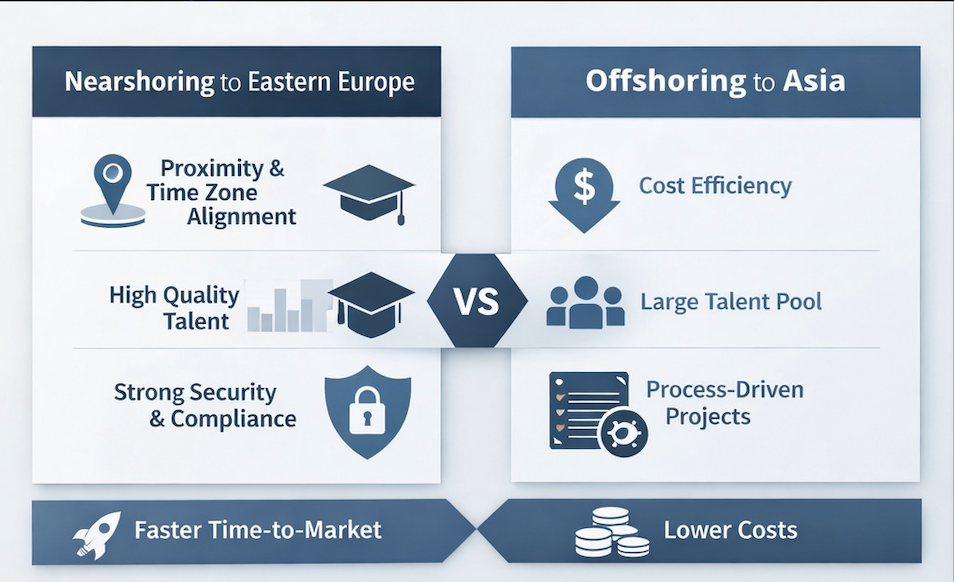
Nearshoring to Eastern Europe
What Defines Nearshoring in Eastern Europe
Nearshoring typically involves partnering with IT teams in countries such as Poland, Romania, Ukraine, Bulgaria, Hungary, and the Baltic states.
Key characteristics include:
- Geographic proximity to Western Europe
- Overlapping or minimal time zone differences
- Strong engineering and technical education systems
- High English proficiency and cultural alignment
Strategic Advantages
Nearshoring to Eastern Europe enables:
- Faster feedback loops due to real-time collaboration
- Higher code quality through shared engineering standards
- Easier integration with in-house teams
- Better alignment with EU data protection and compliance frameworks
This model is often favored for complex, long-term software initiatives rather than isolated tasks.
Offshoring to Asia
What Defines Offshoring to Asia
Offshoring usually refers to outsourcing IT services to regions such as India, Vietnam, the Philippines, and China.
Its appeal is driven by:
- Large talent pools
- Lower average labor costs
- Mature outsourcing ecosystems
Strategic Advantages
Offshoring to Asia can be effective when:
- Cost reduction is the primary objective
- Projects are well-defined and process-driven
- Time zone differences can be managed through structured workflows
This approach is often used for maintenance, testing, and standardized development tasks.
Key Comparison Areas
Cost vs. Total Value
While Asian offshoring typically offers lower hourly rates, nearshoring to Eastern Europe often delivers:
- Lower rework costs
- Faster delivery timelines
- Reduced management overhead
The total cost of ownership frequently narrows or even favors nearshoring over time.
Communication and Collaboration
Eastern Europe provides:
- Near real-time communication with EU teams
- Similar work culture and business expectations
- Fewer misunderstandings in requirements and priorities
In contrast, Asian offshoring often requires additional coordination layers due to time zone and cultural differences.
Time-to-Market
Nearshoring supports:
- Agile development cycles
- Faster issue resolution
- Continuous collaboration across teams
This is especially critical for companies operating in fast-moving or highly competitive markets.
The Technology and Compliance Factor
Regulatory and security requirements increasingly influence sourcing decisions.
Nearshoring to Eastern Europe aligns well with:
- GDPR and EU regulatory standards
- Enterprise security frameworks such as ISO 27001
- Client expectations for data sovereignty
Relevant references:
Industry Insight
According to Gartner, organizations are shifting from pure cost-driven outsourcing toward value-based sourcing models that emphasize agility, resilience, and quality.
McKinsey research also highlights that companies using nearshore models report higher satisfaction and better delivery predictability compared to traditional offshore-only approaches.
References:
Euro IT Sourcing Perspective
From our experience working with European tech firms, nearshoring to Eastern Europe has become the preferred model for companies seeking long-term engineering partnerships rather than transactional outsourcing.
Clients increasingly prioritize:
- Stable, senior-level engineering teams
- Transparent communication and accountability
- The ability to scale teams without compromising quality
At the same time, hybrid models combining nearshore and offshore resources are gaining traction for organizations balancing cost efficiency with strategic control.
Results and Business Impact
Organizations choosing nearshoring over traditional offshoring often report:
- Up to 30 percent faster delivery cycles
- Reduced onboarding and ramp-up time
- Improved product quality and stakeholder satisfaction
- Lower operational risk in regulated environments
These outcomes directly support sustainable growth and predictable delivery.
Key Takeaways
- Nearshoring to Eastern Europe prioritizes collaboration, quality, and speed.
- Offshoring to Asia remains effective for cost-focused, well-scoped projects.
- Total value matters more than hourly rates.
- Compliance and data security are now decisive factors.
- The right model depends on project complexity and strategic goals.
Author & Contact
Author: Matt Borekci
Contact Us: Euro IT Sourcing

Staff Augmentation vs. Project Outsourcing: Which ICT Outsourcing Model Is Right for You?
Discover the key differences between staff augmentation and project outsourcing in ICT. Learn which outsourcing model best suits your business goals, budget, and project timeline.
Reshoring vs Outsourcing: The Hybrid Models Emerging in 2025
Explore how hybrid models combining reshoring and outsourcing are redefining global IT strategies in 2025 for resilience, efficiency, and agility.