Outsourcing UX Research: It’s Not Just for Designers
- 1 min read
Outsourcing UX research enables enterprise teams to reduce risk, validate strategy, and accelerate digital transformation across Europe.

Why UX Research Has Become a Board-Level Concern
For years, UX research was treated as a design support function. That model no longer works.
In enterprise environments, user experience directly impacts revenue, compliance, and digital adoption. Poor usability slows transformation. It increases operational risk. It reduces ROI on IT investments.
Across Europe, digital initiatives are accelerating under regulatory and competitive pressure. According to the European Commission’s Digital Economy and Society Index, organizations are investing heavily in cloud, AI, and data capabilities. Yet many struggle with user adoption.
Outsourcing UX research is no longer a creative decision. It is a strategic one.
The Challenge: Scaling Research Across Complex Enterprise Systems
Large organizations face structural barriers when conducting UX research internally:
- Distributed stakeholders across countries
- Legacy systems with layered complexity
- Compliance requirements under GDPR
- Limited internal research capacity
Many IT departments are optimized for delivery. Not discovery.
When research is delayed or minimized, enterprises experience:
- Feature bloat
- Low user adoption
- Increased change management costs
- Rework after deployment
As highlighted in research by McKinsey & Company, companies that prioritize design and user-centricity significantly outperform peers in revenue growth. However, building in-house research maturity takes time.
The Strategic Approach: UX Research as Risk Mitigation
Outsourced UX research shifts the conversation from design aesthetics to risk control.
Enterprise-level UX research typically includes:
- Stakeholder alignment workshops
- User interviews and behavioral studies
- Journey mapping across digital ecosystems
- Usability validation before large-scale rollout
This approach aligns closely with principles from NIST frameworks around human-centered system design and risk management.
For CIOs and procurement leaders, the key value lies in:
- Faster validation cycles
- Independent, objective research findings
- Cross-market comparability across EU regions
- Controlled research governance
UX research becomes a decision-support system.
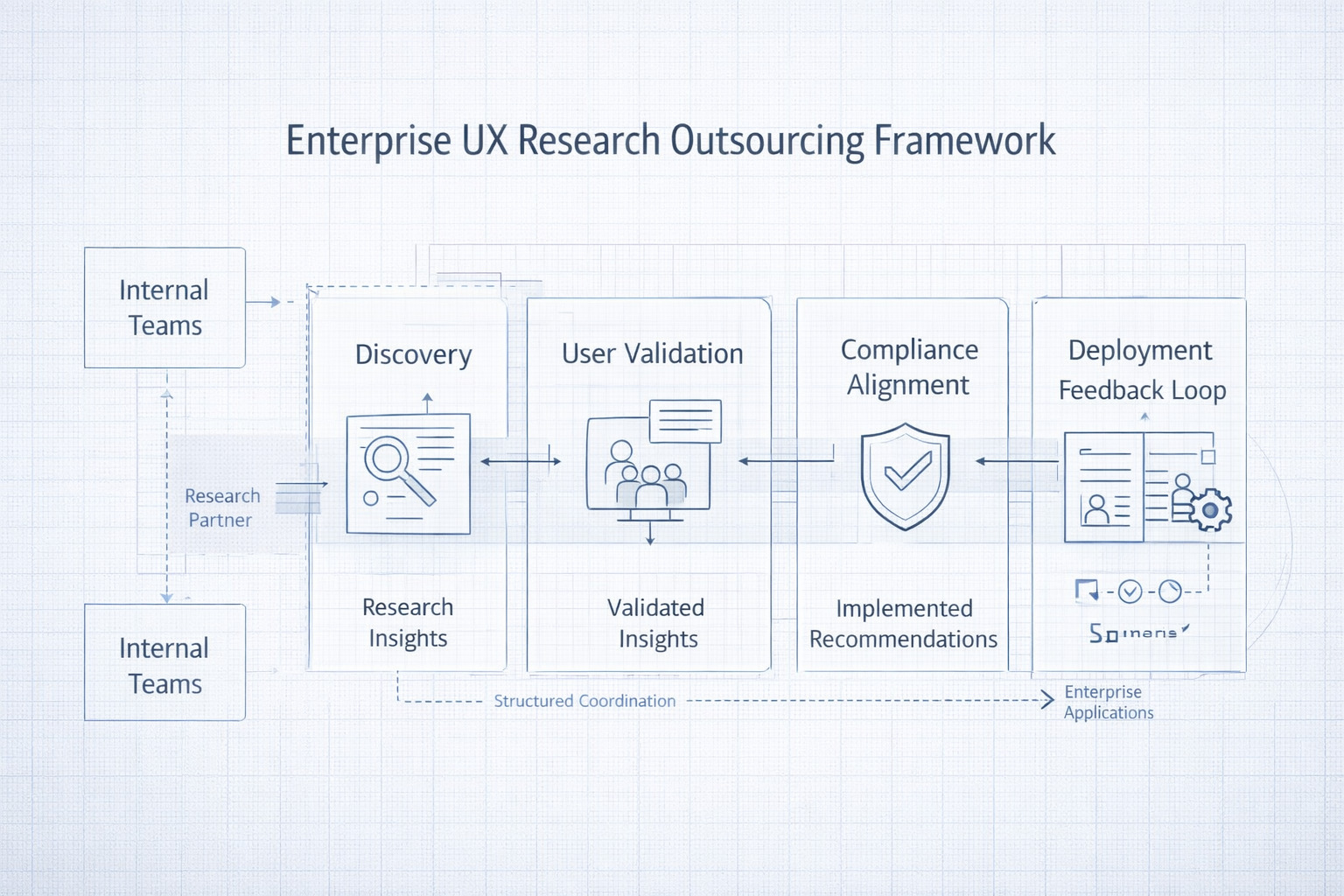
The Delivery Model: Why External Research Teams Add Leverage
Outsourcing UX research does not mean losing control. It means gaining structured expertise.
An effective model typically includes:
1. Embedded Research Pods
External researchers integrate into agile delivery teams while maintaining methodological independence.
2. Remote and Hybrid Testing
Scalable participant recruitment across European markets ensures cultural and regulatory alignment.
3. Standardized Frameworks
Alignment with standards such as International Organization for Standardization usability principles supports enterprise governance.
External teams often bring:
- Mature research operations
- Dedicated participant panels
- Cross-industry benchmarking data
- Scalable tooling ecosystems
This reduces ramp-up time significantly.
Risks and Trade-offs
Outsourcing UX research must be structured carefully.
Common risks include:
- Fragmented knowledge transfer
- Misalignment with product strategy
- Over-reliance on tactical testing
Mitigation strategies include:
- Clear research roadmaps
- Defined ownership between internal and external teams
- Documented research repositories
- Executive-level sponsorship
The objective is not delegation. It is strategic collaboration.
Industry Insight
According to the Design Management Institute and referenced by Gartner in digital experience research, design-led organizations significantly outperform industry averages in long-term shareholder return.
Additionally, European enterprises face growing pressure to comply with accessibility regulations such as the EU Web Accessibility Directive. Structured UX research directly supports compliance validation.
The trend is clear: experience quality is now measurable. And measurable elements demand governance.
Euro IT Sourcing Perspective
From our experience working with European technology-driven organizations, UX research outsourcing is most effective when treated as an enterprise capability - not a project add-on.
We consistently observe three patterns:
- Organizations that embed research early reduce rework cycles.
- Independent research partners surface risks internal teams may overlook.
- Cross-border research creates stronger alignment across European markets.
In complex IT transformations, external UX research acts as a neutral diagnostic layer. It provides clarity before scale.
Results and Business Impact
When structured correctly, outsourcing UX research delivers measurable outcomes:
- 20-40 percent reduction in post-launch rework
- Faster time-to-market through validated roadmaps
- Higher adoption rates in internal enterprise platforms
- Reduced operational risk during digital transformation
These outcomes align directly with enterprise performance KPIs. UX research becomes a financial lever.
Key Takeaways
- UX research outsourcing is a strategic risk mitigation tool, not a design expense.
- Independent research improves objectivity and governance.
- Enterprise-scale digital programs require structured discovery phases.
- European regulatory and accessibility requirements increase the need for validated user insights.
- Treat UX research as an executive decision framework.
Author & Contact
Author: Matt Borekci https://www.linkedin.com/in/matt-borekci
Contact Us: https://www.euroitsourcing.com/en/contact

Multilingual Support Centers in Eastern Europe Explained
Discover how multilingual support centers in Eastern Europe enable cost efficiency, scalability, and enterprise-grade service delivery.

Blockchain Development: When to Outsource Emerging Tech
Learn when outsourcing blockchain development creates strategic advantage, reduces risk, and accelerates enterprise innovation in Europe.