Overlapping Time Zones: Maximizing Collaboration Windows for Distributed IT Teams
- 1 min read
How European enterprises maximize productivity in distributed teams by designing effective overlapping time zones for collaboration and delivery.

Why Time Zones Became a Strategic Constraint for Modern IT
Distributed work is no longer a tactical choice. It is an operating model.
For European enterprises scaling technology teams across borders, time zones have quietly become a limiting factor.
What once felt like a scheduling inconvenience now directly impacts delivery speed, decision latency, and engineering quality. When collaboration windows shrink, coordination costs rise. Meetings multiply. Context gets lost.
In an environment defined by cloud platforms, agile delivery, and continuous deployment, synchronous alignment still matters. Especially when architecture decisions, incident response, or product prioritization are on the line.
The Challenge: When Global Reach Reduces Real-Time Collaboration
Enterprises often assume that distributed automatically means asynchronous. In practice, many workflows still depend on live interaction.
Common friction points include:
- Delayed feedback loops across regions
- Extended decision cycles due to non-overlapping work hours
- Increased dependency on meetings instead of documented processes
- Burnout caused by off-hours calls
Research from McKinsey highlights that poorly coordinated distributed teams can experience up to 30 percent productivity loss due to communication inefficiencies.
This is rarely a tooling issue. It is a time zone design problem.
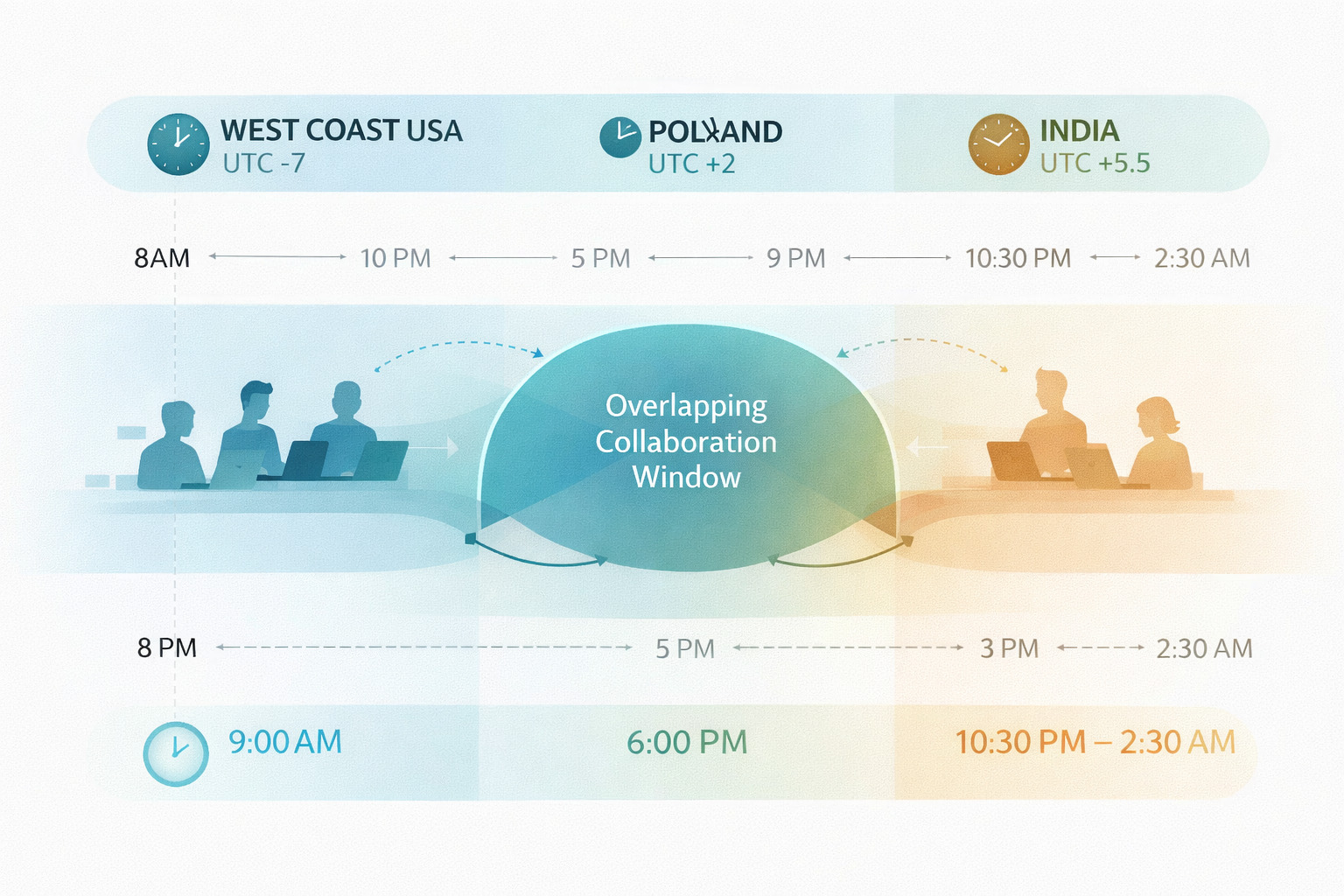
Designing Collaboration Windows, Not Just Schedules
High-performing global teams do not optimize for total coverage. They optimize for intentional overlap.
Effective collaboration windows typically share these characteristics:
- A predictable 2 to 4 hour daily overlap across key roles
- Alignment during high-impact activities such as sprint planning or reviews
- Clear ownership outside overlap hours to avoid blockers
This approach balances synchronous decision-making with asynchronous execution.
It also reduces meeting sprawl and protects deep work time.
Gartner emphasizes that organizations with clearly defined collaboration windows outperform peers in delivery predictability and team satisfaction.
Nearshore and Hybrid Models as a Time Zone Advantage
For European enterprises, geography can be leveraged rather than worked around.
Nearshore delivery models within Europe or adjacent regions offer:
- Natural overlap with core business hours
- Cultural and regulatory alignment
- Faster escalation paths during critical incidents
Instead of spanning 8 to 10 hour gaps, many organizations intentionally design teams within a 1 to 3 hour difference.
This preserves agility without sacrificing access to diverse talent pools.
EU digital workforce studies consistently show higher retention and performance in teams operating within aligned time zones.
Risks and Trade-offs to Acknowledge
Time zone overlap is not a silver bullet.
Potential risks include:
- Overloading overlap hours with meetings
- Creating hidden expectations of constant availability
- Undervaluing asynchronous documentation and handoffs
The goal is not maximum overlap. It is high-quality overlap.
Clear norms, documented decisions, and well-defined escalation paths remain essential.
NIST guidance on distributed systems governance stresses that human coordination models must evolve alongside technical architectures.
Industry Insight: Time Zones as a Productivity Multiplier
A 2024 Deloitte study on global delivery models found that teams with intentional overlap windows:
- Reduced cycle time by an average of 20 percent
- Reported higher clarity in ownership and accountability
- Experienced fewer critical handoff failures
The data suggests that time zone alignment is not an operational detail.
It is a structural performance lever.
Euro IT Sourcing Perspective
From our experience working with European technology-driven organizations, the most successful distributed teams treat time zones as part of system design.
We consistently observe that:
- Teams aligned within European business hours move faster with fewer escalations
- Nearshore models simplify collaboration without compromising scale
- Clear overlap policies reduce both friction and burnout
The pattern is consistent across industries.
When collaboration windows are designed intentionally, delivery stabilizes.
Results and Impact Observed Across Projects
Organizations applying structured overlap models typically see:
- Faster time-to-market through reduced decision latency
- Lower coordination overhead for engineering leaders
- Improved scalability of distributed teams
- Reduced operational risk during incidents or releases
These outcomes compound over time.
Small alignment gains translate into material delivery advantages.
Key Takeaways
- Time zones are a strategic design choice, not a scheduling detail
- Intentional overlap enables faster decisions and clearer ownership
- Nearshore European models naturally maximize collaboration windows
- Asynchronous work still requires strong synchronous anchors
- Productivity improves when overlap is protected and purposeful
Author & Contact
Author: Matt Borekci
https://www.linkedin.com/in/matt-borekci
Contact Us:
https://www.euroitsourcing.com/en/contact

Blockchain Development: When to Outsource Emerging Tech
Learn when outsourcing blockchain development creates strategic advantage, reduces risk, and accelerates enterprise innovation in Europe.

Beyond the Contract: Integrating Outsourced Teams into Your Company Culture
Discover how to integrate outsourced teams into your company culture to drive performance, reduce turnover, and ensure long-term strategic alignment in IT delivery.