QA & Test Automation Outsourcing for Faster Releases
- 1 min read
Accelerate software delivery and improve quality with strategic QA and test automation outsourcing tailored for European enterprises.
Why Quality Assurance Is No Longer Optional for Modern IT Teams
Time to market pressure is growing. European enterprises face digital competition that demands frequent feature releases without quality regressions. Yet many organizations struggle to balance speed with reliability. Traditional in-house QA teams often become bottlenecks if they lack automation, expertise, or capacity.
QA and test automation outsourcing has emerged as a strategic lever to break this tension. When done right, it cuts cycle times, strengthens quality gates, and supports scalable delivery across distributed teams.
The Challenge: Balancing Speed With Quality
Fast releases require disciplined quality engineering, yet:
- Manual testing cannot keep up with frequent iterations.
- In-house teams often lack deep automation skills.
- Peaks in development demand strain limited QA resources.
- Tooling and framework decisions are complex and evolving.
European enterprises pursuing digital transformation cannot afford defects in production. According to Gartner, organizations that adopt continuous testing practices outperform peers in release predictability and defect reduction.¹
Strategic Approach to QA & Test Automation Outsourcing
Outsourcing quality assurance should not be about offloading tasks. The most effective models integrate external QA specialists as partners in your delivery pipeline.
Key considerations:
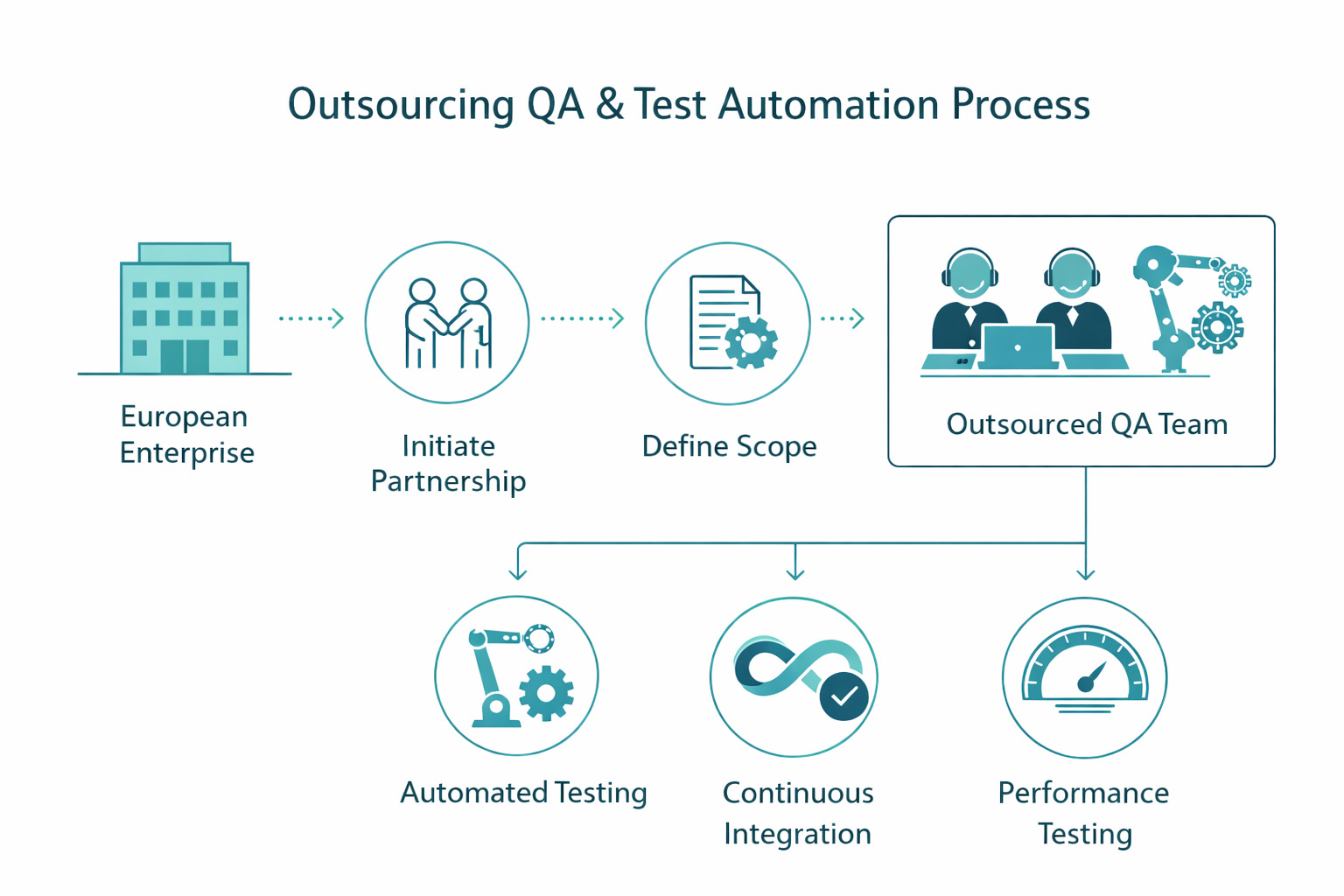
- Scope alignment - Define whether you need regression automation, performance testing, API validation, or full test strategy ownership.
- Integration with DevOps - Outsourced teams must work within your CI/CD workflows to enable continuous testing.
- Clear KPIs - Track metrics like test coverage, defect leakage, and automation ROI to ensure accountability.
- Cultural fit - Shared delivery rhythms and transparent feedback loops reduce friction.
A structured outsourcing model enables your organization to scale quality engineering without diluting process control.
The Technology and Delivery Model
High‑impact outsourced QA integrates tools and frameworks that align with your technology stack and release cadence:
- Automated UI testing with Selenium, Playwright, or Cypress for consistent front end validation.
- API and service testing using Postman, REST Assured, or Pact.
- Performance and load testing through JMeter or Gatling.
- Continuous testing orchestration via pipelines in GitLab CI, GitHub Actions, or Jenkins.
Selecting the right combination of tooling depends on complexity, team expertise, and future scalability. A successful outsourcing partner brings not just execution capacity but tooling expertise tailored to your stack.
Risks and Trade‑offs to Manage
Outsourcing QA brings clear benefits, but executives must manage risks:
- Knowledge transfer gaps can slow ramp periods.
- Misaligned expectations lead to rework.
- Fragmented communication increases defect cycles.
Mitigation starts with a detailed onboarding plan, shared documentation, and regular sprint reviews. A governance model with clearly defined roles keeps accountability tight.
Industry Insight: Why Outsourced Test Automation Is Growing
According to McKinsey, enterprises that embed automation across development deliver features up to five times faster with dramatically fewer defects.² Quality engineering is shifting from a late‑stage gate to a continuous practice supported by automation. For many European IT organizations, partnering with external specialists accelerates this shift without long internal hiring cycles.
Research from ISO and EU digital reports highlights that structured quality practices correlate with reduced operational risk and higher customer satisfaction.³
From Our Experience Working With European Technology‑Driven Organizations
From our work with European enterprises, consistent patterns emerge:
- Teams with strong outsourced QA collaborations ship larger features with fewer rollbacks.
- Companies that treat outsourced QA as strategic partners see automation backlog reductions of 30 percent within six months.
- Shared tooling standards between internal developers and outsourced testers improve test reliability.
Outsourced QA adds value when embedded into your delivery culture rather than treated as an isolated service.
Results and Impact of Strategic QA Outsourcing
Intentional outsourcing can drive measurable outcomes:
- Faster time‑to‑market with reduced testing cycle times.
- Higher automation coverage across regression and integration scenarios.
- Lower defect leakage into production environments.
- Optimized team utilization without overburdening internal staff.
Organizations that leverage strategic QA outsourcing reported up to 40 percent reduction in release bottlenecks, while maintaining compliance with European data and quality standards.
Key Takeaways
- QA and test automation outsourcing accelerates releases while strengthening quality gates.
- Strategic models prioritize integration, clear KPIs, and tooling alignment.
- Outsourcing works best when treated as a collaborative extension of your delivery teams.
- Automated testing frameworks should align with your CI/CD pipelines for maximum impact.
- Effective governance and communication reduce risk and improve outcomes.
Author: Matt Borekci
https://www.linkedin.com/in/matt-borekci
Contact Us:
https://www.euroitsourcing.com/en/contact
References:
- Gartner on Continuous Testing Practices
- McKinsey on Automation and Software Delivery Productivity
- ISO/European Digital Quality Frameworks

Turkish Tech Renaissance: The Remarkable Growth of the IT Industry
Turkey's IT industry is rapidly growing, driven by its strategic geographic location, a young and educated workforce, and strong government support. The country's thriving startup ecosystem, emphasis on digital transformation, and increasing IT exports are positioning Turkey as a significant player in the global technology landscape. This growth trajectory highlights Turkey's potential and ambition in shaping the future of technology both domestically and internationally.

TURKIYE: The Rising Star of IT Outsourcing
Turkey is quickly becoming a key player in the IT outsourcing industry, thanks to its strategic location, skilled workforce, and cost-effective solutions. Positioned between Europe and Asia, Turkey offers businesses access to top-tier IT talent at competitive prices, with minimal language and cultural barriers. The country's commitment to data protection and innovation further enhances its appeal as a reliable and cutting-edge IT outsourcing partner.