The Daily Routine of a Cyber Security Expert: What They Really Do
- 1 min read
Explore the daily routine of a cyber security expert and how structured security operations protect modern enterprises.
Cybersecurity Is Not a Department - It Is a Daily Discipline
Cybersecurity is often perceived as reactive. A breach happens. A team responds.
The reality is different.
The daily routine of a cyber security expert is structured, analytical, and preventative. In European enterprise environments, where regulatory pressure and digital exposure are rising, cybersecurity operations are continuous. Not episodic.
From financial institutions to industrial technology firms, digital resilience depends on disciplined daily execution. Not occasional intervention.
The Morning: Threat Monitoring and Risk Assessment
The day typically begins with visibility.
Cyber security experts review:
- Security Information and Event Management dashboards
- Threat intelligence feeds
- Overnight alerts and anomalies
- Endpoint detection reports
- Network traffic irregularities
Security Operations Center - SOC teams prioritize alerts based on risk impact and business exposure.
Frameworks such as the NIST Cybersecurity Framework emphasize continuous monitoring as a foundational pillar of cyber defense.
The goal is simple. Detect early. Escalate appropriately. Minimize impact.
Midday: Incident Response and Investigation
Not every alert becomes an incident. But some do.
When suspicious activity escalates, experts move into investigation mode.
Core activities include:
- Log analysis
- Forensic review of affected endpoints
- Containment strategies
- Coordinating with IT infrastructure teams
- Documenting findings for compliance
According to ENISA, incident response maturity significantly reduces operational downtime in European enterprises.
Precision matters. Overreaction disrupts operations. Underreaction increases exposure.
Vulnerability Management and System Hardening
Cybersecurity is not only about responding. It is about reducing attack surface.
A typical day includes:
- Reviewing vulnerability scan results
- Coordinating patch management
- Assessing third-party software risk
- Validating configuration baselines
- Reviewing access control permissions
Standards like ISO 27001 require structured risk management processes integrated into daily operations.
Security experts work closely with DevOps and infrastructure teams to ensure remediation does not compromise performance.
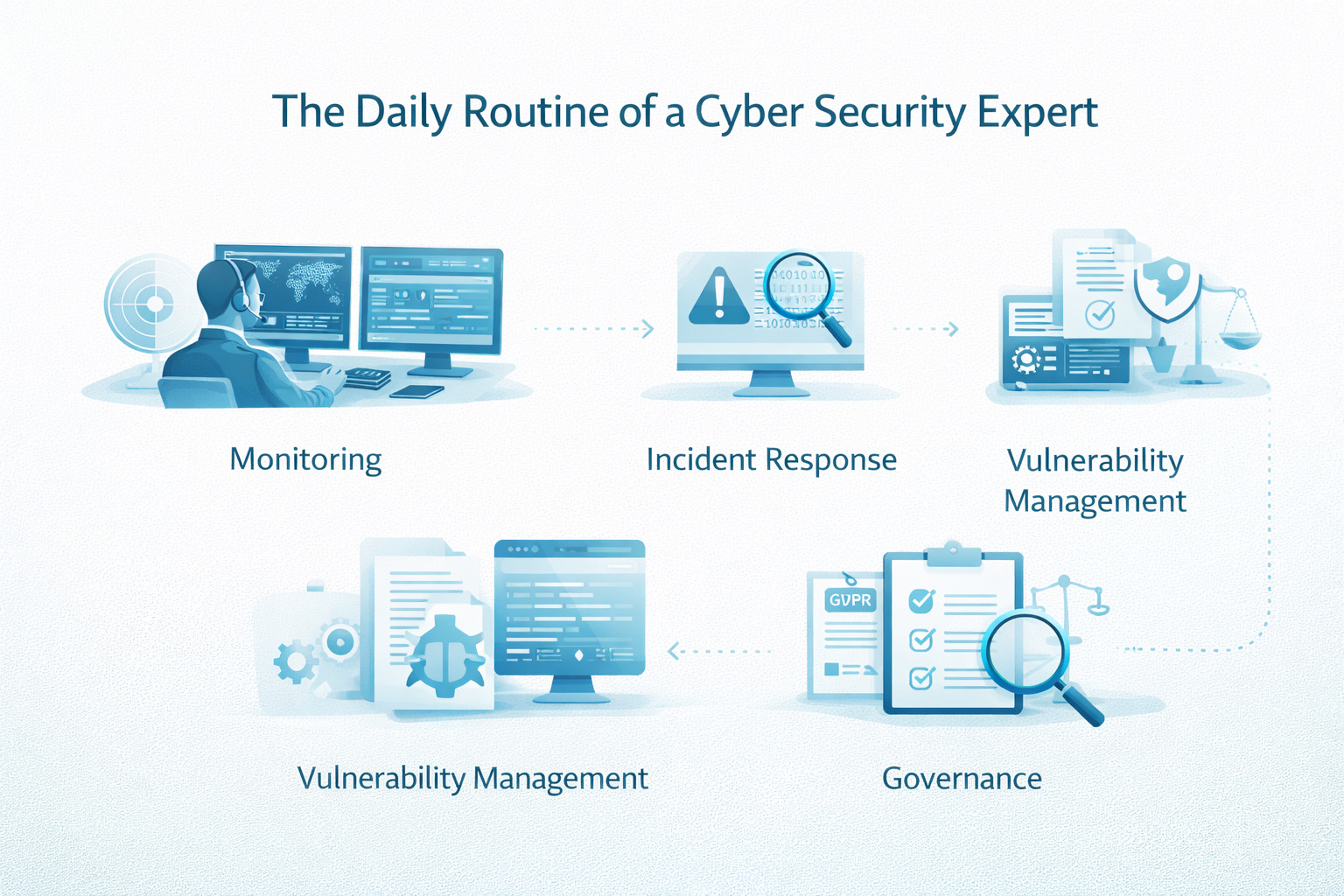
Governance, Compliance, and Documentation
European organizations operate under strict regulatory landscapes including GDPR and sector-specific standards.
Cyber security professionals spend a significant portion of their day on:
- Updating risk registers
- Preparing compliance documentation
- Reviewing vendor security posture
- Conducting internal control checks
- Supporting audit preparation
Gartner research consistently highlights governance and third-party risk management as top CIO priorities.
Security is not only technical. It is procedural and strategic.
Strategic Planning and Security Architecture
Beyond daily operations, cyber security experts contribute to long-term resilience.
This may involve:
- Evaluating zero-trust architecture initiatives
- Reviewing cloud security configurations
- Designing network segmentation strategies
- Assessing identity and access management frameworks
- Participating in digital transformation initiatives
Cybersecurity increasingly influences enterprise architecture decisions.
Security is embedded into infrastructure design, not layered afterward.
Industry Insight
According to McKinsey research, organizations that embed cybersecurity into digital transformation initiatives reduce breach costs and improve recovery speed.
ENISA reports show that supply chain vulnerabilities and ransomware remain dominant threats in Europe.
The modern cyber security expert operates within this evolving threat ecosystem. Their daily routine reflects a balance between vigilance, engineering, and governance.
Cybersecurity roles are expanding beyond technical silos into enterprise-wide risk management functions.
Euro IT Sourcing Perspective
From our experience working with European technology-driven organizations, we observe that mature cybersecurity teams share common characteristics.
They operate with:
- Clear incident response playbooks
- Defined escalation paths
- Strong integration between development and security
- Continuous monitoring infrastructure
- Executive-level visibility into cyber risk
We see a shift toward proactive security engineering rather than reactive defense.
The most resilient enterprises treat cybersecurity as an operational rhythm. Not an emergency function.
Results and Impact
When cybersecurity operations are structured and disciplined, organizations typically achieve:
- Reduced incident response time
- Lower breach impact costs
- Improved regulatory compliance readiness
- Higher stakeholder trust
- Stronger digital transformation resilience
In measurable terms, mature security operations can reduce downtime and enhance enterprise risk visibility.
Cyber security experts are not only defenders. They are enablers of sustainable digital growth.
Key Takeaways
- The daily routine of a cyber security expert combines monitoring, response, governance, and strategy
- Continuous monitoring is foundational to enterprise resilience
- Vulnerability management reduces long-term operational risk
- Governance and documentation are as critical as technical controls
- Cybersecurity maturity directly impacts business continuity and digital scalability
Author & Contact
Author: Matt Borekci https://www.linkedin.com/in/matt-borekci
Contact Us: https://www.euroitsourcing.com/en/contact
What Does a Cyber Security Expert Do? A Complete Guide
Discover what a cyber security expert does, their roles, skills, and how they protect businesses from digital threats.

How Much Does a Cyber Security Expert Earn? Salary Insights for 2025
Explore 2025 cybersecurity salary trends, including global averages, roles in demand, and how outsourcing impacts IT security hiring.