Why AI-First Vendors are Disrupting the Traditional Outsourcing Market
- 1 min read
AI-first vendors are dismantling the legacy outsourcing model. Discover how automation and specialized engineering pods are redefining enterprise ROI and delivery.
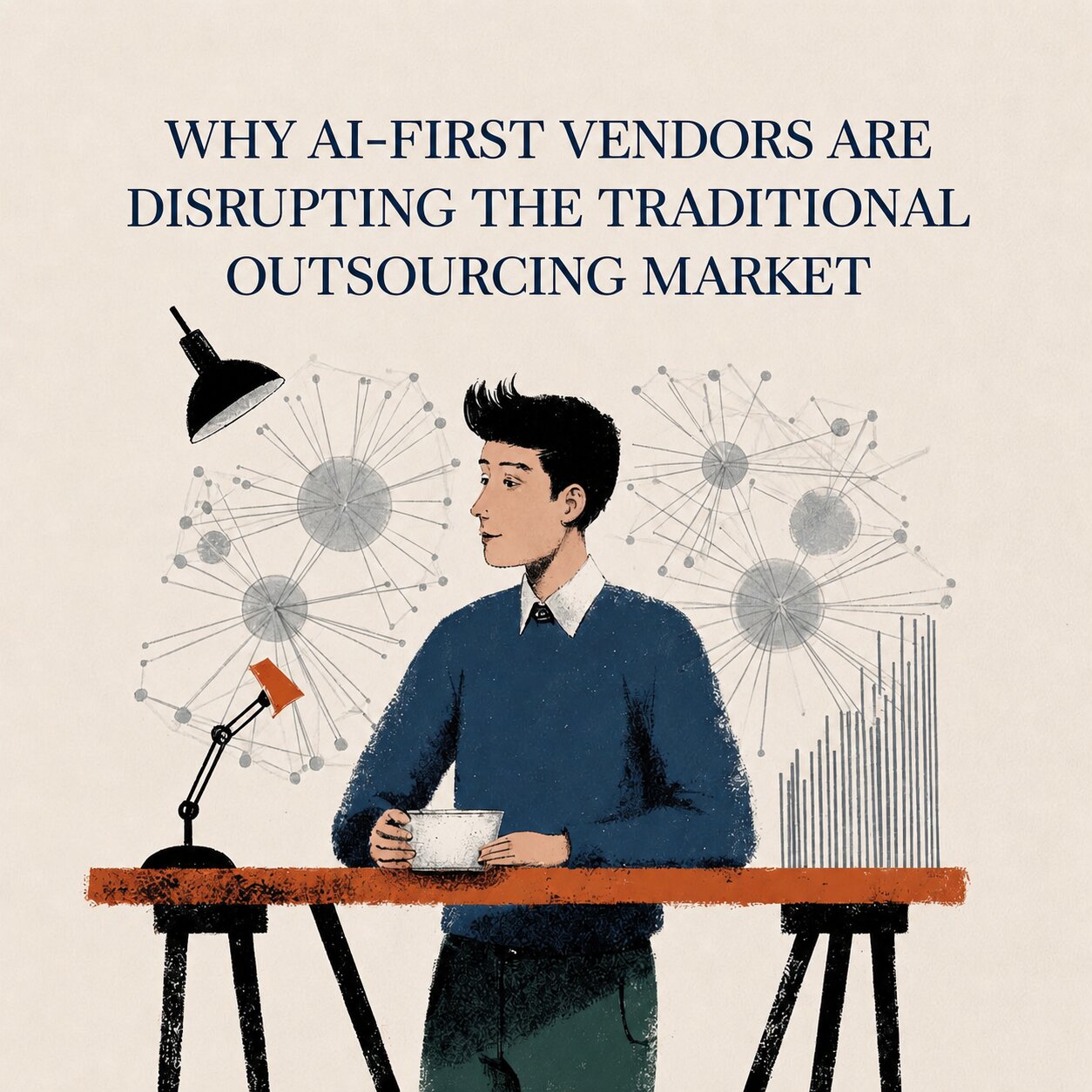
The Efficiency Trap: Why Legacy Outsourcing Models Are Breaking
Traditional IT outsourcing was built on a simple, linear premise: labor arbitrage. For decades, the "man-month" was the standard unit of value. This model incentivized headcount over outcomes, leading to bloated teams and a slow accumulation of technical debt. In the current European economic landscape, where agility is a survival trait, this sluggish approach is no longer sustainable.
The friction between legacy processes and the need for rapid digital evolution has reached a breaking point. AI-first vendors are not just using new tools; they are fundamentally re-engineering the delivery pipeline. By integrating generative AI and automated workflows into the core of the development lifecycle, these modern partners are achieving what was previously thought impossible: higher quality at a significantly accelerated pace.
This shift is particularly relevant for enterprise-scale organizations in Europe. With strict regulatory environments and a high demand for specialized talent, the move toward leaner, AI-augmented engineering pods is becoming the preferred strategy for CTOs who need to do more with less.

The Core Shift: From Capacity to Capability
Traditional vendors sell you "bodies" to fill a gap. AI-first vendors sell you "solutions" powered by enhanced capabilities. The disruption occurs because the fundamental cost structure of software production has changed.
The Productivity Multiplier
When developers utilize AI-powered IDEs and automated testing frameworks, the "boilerplate" work that once took days now takes minutes. This allows engineering teams to focus on architectural integrity and business logic. For a CIO, this means the budget is no longer spent on maintenance, but on innovation.
Eliminating the Communication Tax
One of the greatest hidden costs in outsourcing is the "communication tax" - the overhead of managing large, disparate teams. AI-first models favor compact, high-output pods. Small teams using integrated AI tools can often outpace larger, traditional teams because there is less organizational friction and more direct focus on the product.

Strategic Risk Mitigation in the AI Era
Adopting an AI-first partner is not without its considerations. Forward-thinking procurement leaders are now evaluating vendors based on their AI governance and data security protocols.
- Code Provenance: Ensuring that AI-generated code is compliant with open-source licenses.
- Security Scanning: Automated, continuous security audits within the CI/CD pipeline to prevent vulnerabilities.
- IP Protection: Clear legal frameworks regarding how AI models interact with proprietary enterprise data.
According to research by Gartner, organizations that integrate AI into their software engineering workflows will see a 30% increase in productivity by 2026. However, this gain is only realized if the vendor has a robust framework for managing the "human-in-the-loop" aspect of development.
Industry Insight: The Death of the "Black Box" Vendor
Market data suggests a pivot toward transparency. According to recent McKinsey reports, the gap between "top-tier" digital performers and laggards is widening. The disruptors in the outsourcing space are those who provide full visibility into their development velocity and code quality metrics.
The "black box" model - where a client sends requirements and waits months for a delivery - is being replaced by real-time, collaborative ecosystems. AI tools provide the telemetry needed for this level of transparency, giving stakeholders a clear view of progress and potential roadblocks before they become costly failures.

Euro IT Sourcing Perspective
From our experience working with European technology-driven organizations, we have observed that the most successful transitions occur when companies stop viewing AI as a "feature" and start viewing it as a foundational methodology.
We have seen that AI-augmented teams do not just work faster; they work smarter. By automating the mundane, our engineers are free to solve the complex cross-border integration challenges and regulatory compliance hurdles that are unique to the European market. The disruption we are seeing is not just about technology; it is about the liberation of human talent from repetitive tasks.
Results and Impact: Redefining ROI
The shift to AI-first vendors produces measurable improvements across the board:
- Accelerated Time-to-Market: Product cycles are often reduced by 40% through automated testing and code generation.
- Higher Code Quality: Reduced bug density due to continuous AI-driven linting and review processes.
- Operational Elasticity: The ability to scale engineering output without a linear increase in headcount.
- Reduced Technical Debt: Proactive refactoring suggestions from AI tools help maintain a clean codebase from day one.
Key Takeaways
- Outcome over Headcount: Evaluate vendors based on their ability to deliver results, not the size of their bench.
- AI Integration is Mandatory: A vendor without a clear AI-augmented workflow is a legacy risk to your organization.
- Transparency as a Metric: Prioritize partners who offer real-time visibility into the development process.
- Small Pods, Big Impact: Look for leaner, specialized teams that leverage automation to outperform traditional large-scale teams.

Author: Matt Borekci
https://www.linkedin.com/in/matt-borekci
Contact Us:
https://www.euroitsourcing.com/en/contact

From Outsourcing to Co-Creation: The Evolution of Vendor Partnerships
Explore how vendor relationships are shifting from outsourcing to co-creation, driving innovation, agility, and long-term business value.
The Rise of AI-First Outsourcing Vendors: What Sets Them Apart
Discover how AI-first outsourcing vendors transform IT services with smarter automation, efficiency, and innovation.