Outsourcing DevOps and CI-CD: Accelerate Release Cycles Without Losing Control
- 1 min read
Outsourcing DevOps and CI-CD helps enterprises accelerate release cycles, improve reliability, and scale securely across European IT environments.
Why Release Velocity Has Become a Board-Level Metric
European enterprises no longer compete on features alone. They compete on speed, stability, and scalability.
Digital transformation has shifted expectations. Business units demand faster releases. Customers expect continuous improvement. Regulators require resilience and compliance.
Yet many organizations struggle to align development and operations at scale. Internal DevOps teams are overloaded. Toolchains are fragmented. Cloud adoption outpaces governance.
This is where outsourcing DevOps and CI-CD becomes a strategic lever rather than a cost decision. The goal is not externalization. The goal is acceleration with control.
The Core Challenge: Speed vs Stability
Enterprises often face a structural dilemma.
- Faster releases increase competitive advantage
- Rapid change introduces operational risk
- Distributed teams create coordination gaps
- Legacy systems resist automation
Without mature CI-CD pipelines, deployments remain manual. Testing is inconsistent. Rollbacks are slow.
According to the State of DevOps Report by Google Cloud, high-performing teams deploy multiple times per day while maintaining lower failure rates. The difference is not effort. It is engineering discipline.
Outsourced DevOps partners bring structured frameworks that many internal teams lack time to build from scratch.
Strategic Approach: DevOps as an Operating Model
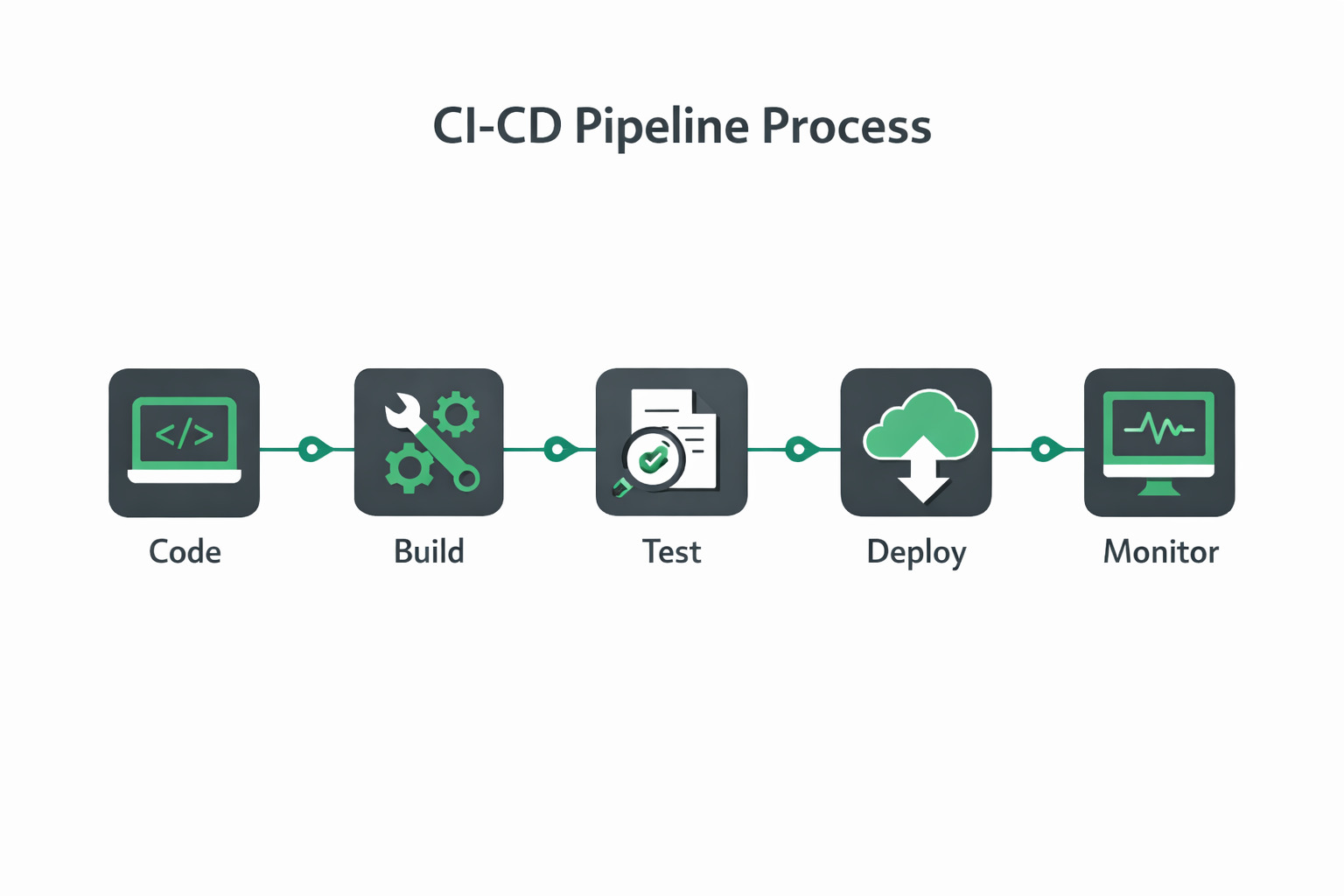
Outsourcing DevOps is not about adding engineers. It is about implementing an operating model built on automation and measurement.
Key pillars include:
1. Pipeline Standardization
- Unified CI pipelines across repositories
- Automated test orchestration
- Infrastructure as Code adoption
2. Deployment Automation
- Blue-green and canary deployments
- Containerized workloads
- Kubernetes-based orchestration
3. Observability and Feedback Loops
- Real-time monitoring
- Automated alerting
- Performance benchmarking
Frameworks aligned with NIST secure software development guidelines and ISO 27001 standards ensure compliance remains embedded, not bolted on.
For reference, NIST secure development practices emphasize automation, traceability, and risk management as critical DevOps components: https://www.nist.gov/itl/ssd
The Delivery Model: Nearshore DevOps Teams in Europe
European organizations increasingly adopt nearshore DevOps outsourcing models for three reasons:
- Time zone alignment
- Regulatory familiarity with EU standards
- Strong engineering talent pools in Eastern Europe
A nearshore DevOps team typically integrates directly into the client’s cloud environment while operating under defined SLAs and governance frameworks.
The model often includes:
- Dedicated DevOps engineers
- Cloud architects
- Automation specialists
- Security engineers
This hybrid structure allows enterprises to maintain architectural ownership while accelerating execution.
Risks and Trade-offs to Consider
Outsourcing DevOps without governance can introduce new risks.
Common pitfalls include:
- Tool sprawl across vendors
- Security misalignment
- Lack of documentation ownership
- Overdependence on external expertise
Mitigation requires:
- Clear architecture standards
- Shared dashboards and metrics
- Transparent backlog management
- Defined exit and knowledge transfer plans
McKinsey research highlights that digital transformation initiatives fail primarily due to organizational misalignment rather than technology gaps: https://www.mckinsey.com/capabilities/mckinsey-digital
DevOps outsourcing must therefore align with enterprise strategy, not operate as an isolated technical function.
Industry Insight: High Performers Deploy 200x More Frequently
Research consistently shows that elite DevOps performers achieve:
- 200x more frequent deployments
- 24x faster recovery times
- Significantly lower change failure rates
These benchmarks, cited across industry DevOps studies, demonstrate that automation maturity directly impacts business resilience.
European enterprises under regulatory pressure cannot afford unstable release cycles. Structured CI-CD pipelines reduce both operational risk and compliance exposure.
Euro IT Sourcing Perspective
From our experience working with European technology-driven organizations, most DevOps bottlenecks are not technical limitations. They are process maturity gaps.
We observe recurring patterns:
- CI pipelines exist but lack standardization
- Cloud environments grow without governance layers
- Release processes remain partially manual
When DevOps is treated as a scalable engineering system rather than a support function, release cycles compress dramatically while stability improves.
Nearshore DevOps collaboration also improves cultural alignment and documentation quality compared to offshore-only models.
Results and Business Impact
Organizations that successfully outsource DevOps and CI-CD typically report:
- 30 to 50 percent faster release cycles
- Reduced deployment failure rates
- Lower infrastructure waste through automation
- Improved audit readiness
- Faster cloud migration timelines
Beyond speed, the deeper impact lies in predictability. Forecastable release cadences enable better product planning and revenue alignment.
Key Takeaways
- Outsourcing DevOps is a strategic acceleration model, not a staffing decision
- Standardized CI-CD pipelines are the foundation of release velocity
- Nearshore European teams reduce regulatory and communication friction
- Automation improves both speed and compliance
- Governance frameworks must be defined before scaling
Author & Contact
Author: Matt Borekci https://www.linkedin.com/in/matt-borekci
Contact Us: https://www.euroitsourcing.com/en/contact

From Vendor to Strategic Ally: Rethinking the Outsourcing Relationship
Discover how modern outsourcing evolves from transactional vendor models to strategic partnerships that drive innovation and long-term business growth.

Cloud Migration Projects: Why Outsource the Heavy Lifting?
Discover why outsourcing cloud migration projects reduces risk, accelerates delivery, and improves cost control for modern enterprises.